
Bengal cats can get along with dogs, but it doesn’t happen by magic. Success usually depends on early socialization, temperament, and a careful introduction process. With patient, structured “slow meets,” many Bengal cats learn that a dog is just another household roommate—not a threat.
Do Bengal cats get along with dogs?
Often, yes—when the conditions are right. Bengal cats are typically energetic, curious, and socially “people-forward,” which can translate into interest in the dog rather than fear. That said, Bengal temperament is not identical for every cat, and the dog’s personality matters just as much. If your dog is high-drive, bouncy, and persistent, your Bengal may interpret that as harassment.
My opinionated bottom line: if you’re hoping for instant harmony, you’ll be disappointed. If you’re willing to manage the first 1–3 weeks like a training project, your chances go way up.
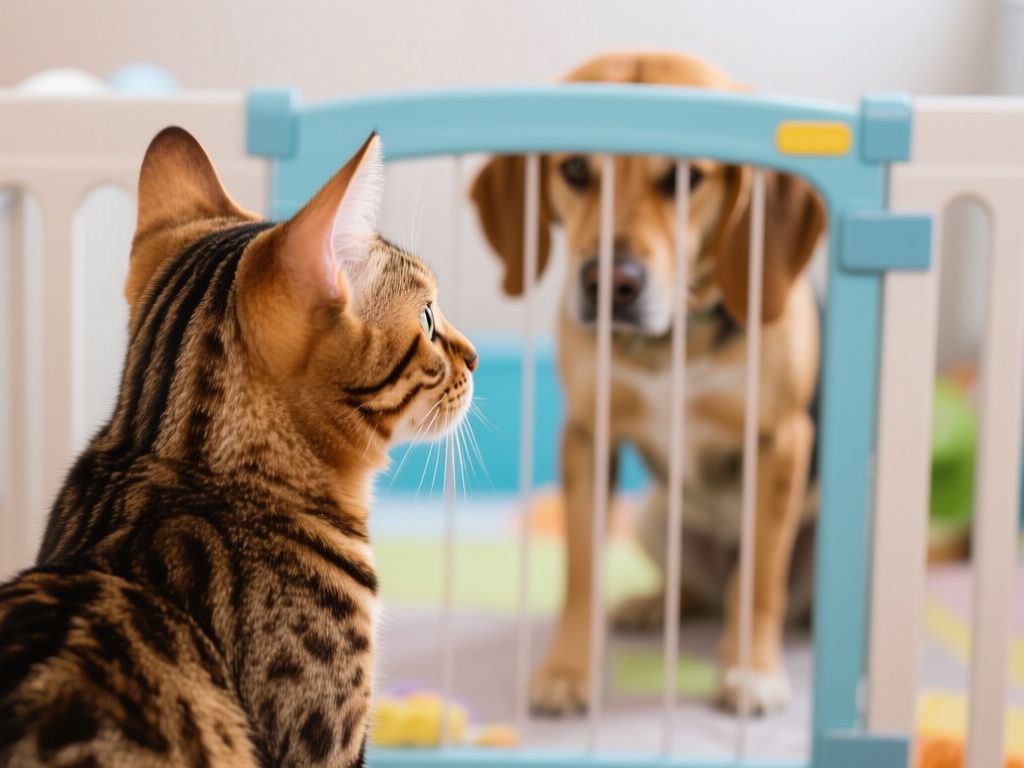
How do Bengal cats behave around dogs?
Bengal cats commonly communicate through movement and “watching.” In a first encounter, you might see:
- Stiff posture, slow blinks, and focused staring (curious or cautious).
- Tail up or tail flicking (emotion is ramping up—watch for context).
- Zoomies or sudden darting (often a release of stress, not “play”).
- Hiding at first, then returning to observe from a safer perch.
They also tend to use vertical space. Bengals often prefer cat trees, shelves, or a tall room corner where they can monitor without feeling trapped. A dog that can’t “respect” that distance may trigger defensive behavior—hissing, growling, swatting, or prolonged avoidance.
What about the dogs? (Because they’re not all the same.)
Dogs vary massively in how they approach cats. A calm, confident dog that can ignore the cat during a controlled introduction is usually a better candidate than a dog that lunges, chases, or barks at every unfamiliar animal. Even “friendly” dogs can cause problems if their excitement looks like chasing.
In real homes, the best matches tend to be:
- Dogs that can sit/lie down and look away on cue.
- Dogs with low prey drive or those that’ve already lived with cats.
- Dogs that respond to management (leash, gates) without escalating.
It only takes one bad moment—a dog that suddenly bolts toward the cat—to create a lasting fear memory for the Bengal. So yes, your dog’s training history matters.
What factors decide whether they’ll get along?
Several variables usually decide the outcome more than pure species stereotypes.
1) Age and “social learning” timing
Generally, younger cats and dogs may adapt faster because they’re still forming expectations about what’s normal. However, older Bengal cats can do great too—if they have a stable routine and you introduce the dog in a way that doesn’t overwhelm them.
2) Temperament on both sides
A Bengal that’s relaxed, food-motivated, and accustomed to visitors may accept a dog sooner than a Bengal that’s already skittish or territorial. Likewise, a dog that’s reactive to motion may be a rough starting point.
3) Indoor environment and escape routes
Bengals benefit from having “control” of their space. The presence of cat towers, high shelves, and closed doors (used strategically) can reduce conflict. A dog that can access every room without restrictions increases tension.
4) Introduction method (this is the big one)
Managed introductions teach both animals the same message: the other one is predictable, not chaotic. Rushed meetings often teach the opposite.
How to introduce a Bengal cat to a dog (step-by-step)
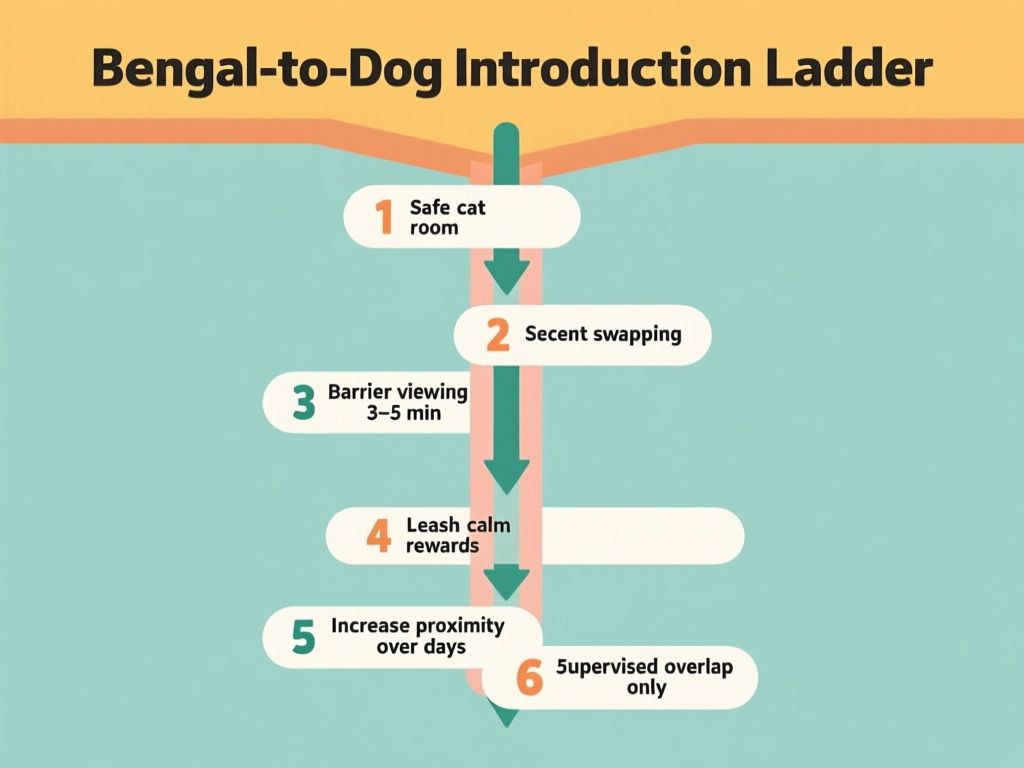
If you want the practical version, this is the method I’d recommend to most beginners. It’s structured, boring, and effective—like most good cat/dog training.
-
Create a “safe cat zone.” Pick one room for the Bengal: with food, water, litter, and a vertical escape option (cat tree or shelves). Use a baby gate or closed door so the dog can’t access this space freely.
-
Start with scent swapping. Feed or reward each animal near the other’s scent (an item from the dog’s area for the cat, and an item from the cat’s area for the dog). This builds familiarity without face-to-face tension.
-
Use controlled, short meetings. Put the dog on a leash. Let the cat observe from the safe zone or from a barrier (like a gate). Keep the session brief—think 3–5 minutes at first—then end on a calm note.
-
Watch for “decision moments.” If the Bengal freezes, crouches, growls, or tries to swat repeatedly, the session is too intense right then. If the dog strains forward or lunges, increase distance or end the session early.
-
Reward calm behavior. Give treats to the dog for staying relaxed and to the cat for choosing to remain in the interaction area instead of fleeing. The goal is: calm becomes rewarding.
-
Gradually increase time and proximity. Over days, expand access: a longer leash distance, then a room overlap with supervision. “Slow” usually beats “successful for one day.”
-
Never skip supervision at first. Even if they seem okay after a week, supervise for any unscripted behavior—especially around food, toys, or resting spots.
What signs mean things are going well?
Watch for patterns across multiple sessions, not a single lucky moment.
- The Bengal returns to observe instead of hiding for the entire session.
- The dog can see the cat without barking, lunging, or chasing.
- Reduced “spikes” in behavior (less staring followed by sudden swatting or sudden dog surges).
- Both animals settle into normal activities afterward (eating, using litter, relaxing).
What signs mean you should slow down?
These behaviors don’t automatically mean “they will never get along,” but they do mean you should adjust management and pacing immediately.
- Bengal persistent pursuit attempts (stalking the dog, repeated swatting attempts, escalating vocalization).
- Dog fixation behaviors (hard staring, whining, repeated lunging toward the cat).
- Resource guarding energy (snapping around the cat’s food, rushing the litter area, or intense toy guarding).
- Fear responses that last (the Bengal won’t come out, stops eating, or panics during every attempt).
If you see these consistently, increase separation, extend scent swapping, and shorten sessions. If severe fear or aggression persists, getting help from a qualified trainer or behaviorist is worth it.
Can they cuddle or share space?
Sometimes, yes. But it’s not a requirement for “getting along.” Shared space can start as shared calm—same room, same time, low conflict—before it becomes affection. For Bengals, “getting along” often looks like tolerating the dog within the Bengal’s personal boundaries, especially if the cat can access a high perch and the dog can settle.
Also, don’t force “cuddling.” If you push the animals into closeness before they’re ready, you can create a conflict loop: Bengal feels trapped, dog feels rewarded by pursuit, and the dog learns to chase.
Common mistakes beginners make
- Letting the first meeting be unsupervised. One chase can set back weeks of progress.
- Assuming friendliness equals calm. A wagging tail can still mean high arousal and poor self-control.
- Ignoring the cat’s escape route. If there’s no “exit,” a Bengal may escalate because it feels cornered.
- Changing routines too fast. Bengals like predictability. Big schedule shifts add stress during introductions.
- Using punishment. Scolding can increase fear and make animals associate each other with bad outcomes.
Is it worth trying? (My practical take)
In most households, trying is worth it if you can manage the setup. The key is whether you can commit to supervised interactions, barriers, and gradual steps. If you can’t supervise frequently or your dog has a strong history of chasing cats, you’ll need a different plan—sometimes that means postponing introductions or adjusting expectations.
That “worth it” decision is mainly about logistics and training effort, not about whether Bengal cats are “supposed” to be dog-friendly.
Frequently Asked Questions
Will my Bengal cat always be okay with a dog?
No. Some Bengals remain cautious, and some dogs remain too excited or prey-driven. Even in friendly situations, you should treat early interactions as learning—things can improve, but unpredictability exists.
How long does it usually take for Bengals and dogs to get along?
It depends on temperament and the introduction pace, but many households see meaningful improvement within 2–3 weeks of consistent, controlled exposure. Some pairs take longer, especially if either animal is older or particularly reactive.
What if my dog chases the cat?
That’s a red flag. Don’t allow chase behavior during introductions. Increase distance, reinforce “leave it”/settle skills, and keep the Bengal in a space with vertical escape options. If the chasing is intense or persistent, consult a qualified trainer to address predatory or reactivity behavior safely.
Can I introduce them if I don’t have a separate room?
You can often improvise with barriers, but the essentials are still separation and escape routes. Use baby gates, closed doors, and a cat-accessible high space. You’ll also need a way to control the dog’s access and keep sessions short and supervised.
Do Bengal cats hate dogs?
Not by default. Bengals aren’t “dog-haters” as a rule. They’re more accurate to describe as high-curiosity cats that can react strongly to sudden movement, especially if they feel cornered or unable to control distance.
Should I use treats during introductions?
Yes—treats are one of the easiest ways to pair the other animal with something pleasant. Reward calm, not chaos. For the Bengal, the treat can be placed near the barrier or used when the cat chooses to stay relaxed and watch instead of escalating.
If you remember one thing: a Bengal’s confidence grows when it can choose distance. Build that choice into your introduction, and you’ll usually get far better results than hoping for instant friendliness.

Mim Creation
Writer at Helmet Today, covering helmet reviews, fit and riding safety.