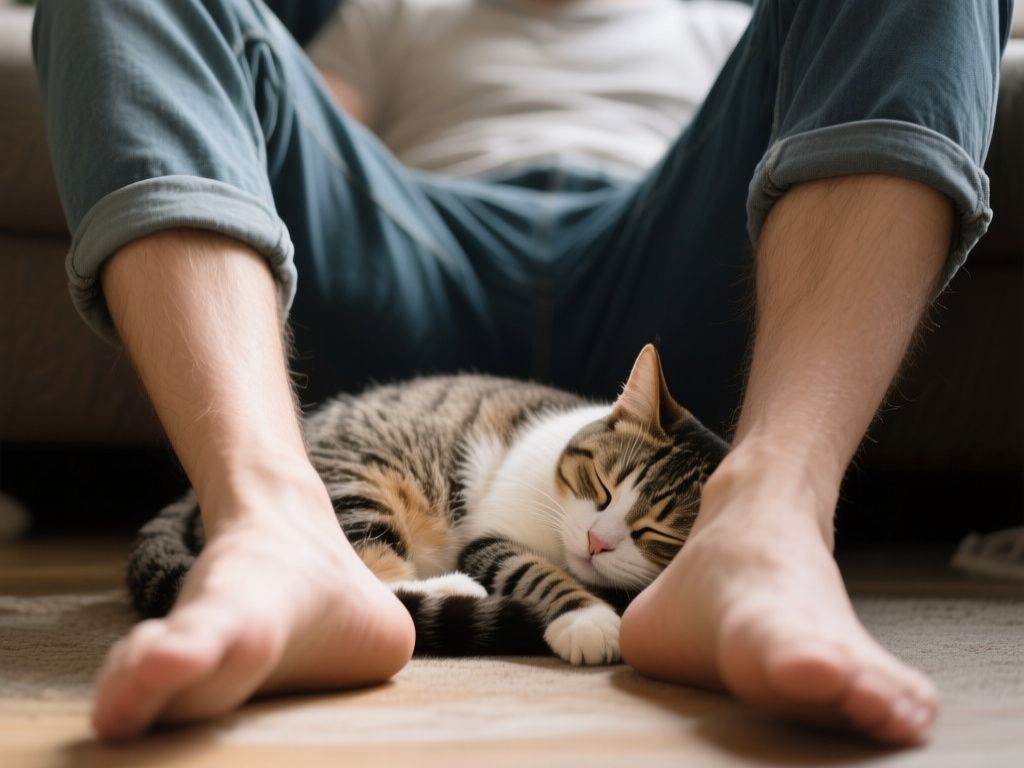
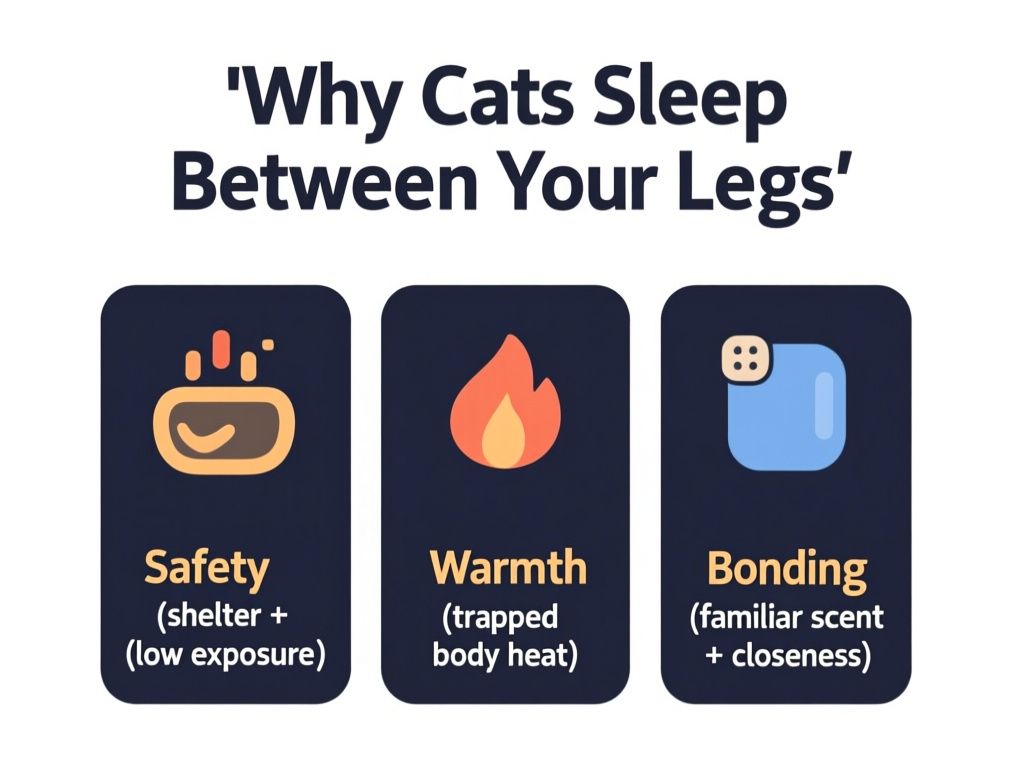
Cats often sleep between your legs because it feels safe, warm, and socially familiar. That spot also offers good “overlap” access to you: they can monitor your movement while staying sheltered. If your cat also purrs or kneads there, it usually points to comfort and trust.
Why does my cat choose the space between my legs?
Your legs create a cozy little nook—two warm surfaces, a narrow tunnel of shelter, and a predictable moving boundary when you shift positions. Cats tend to pick sleeping areas that combine warmth, safety, and closeness to their favorite creature. When your cat slides between your legs, they’re basically turning your body into a guardrail and a blanket at the same time.
There’s also a social layer. Many cats see their humans as part of their “group,” and sleeping near you can be a comfortable way to stay bonded. Between your legs specifically, they can rest while keeping track of you—watching your feet, hands, and posture without having to expose their vulnerable belly on open ground.

How does this spot feel safer for cats?
From a cat’s point of view, sleep is when they’re least able to react quickly. Even relaxed cats still need a safe “launch pad” if something changes. The space between your legs offers multiple safety signals at once:
- Shelter from above and sides: Your body blocks the view of potential surprises.
- Familiar scent: Your skin and clothing carry your day’s scent trail. Cats often find that comforting and grounding.
- Reduced exposure: If your cat can tuck in closer to the center line of your body, they don’t have to sleep fully in the open.
- Predictable movement: When you stand or move, your legs provide a “boundary” that stays in roughly the same place relative to them.
In practice, you may notice that your cat doesn’t just sleep there randomly—it’s most likely when the room is quiet, when you’re stationary (like reading or watching TV), or during cooler weather when your body is radiating warmth.
Is it about warmth, comfort, or both?
Yes—usually both. Cats regulate body temperature carefully, and humans are naturally good heat sources. Your legs are warm, and the narrow space between them traps that warmth like a mini tent. Even if your cat has a bed nearby, they might choose the “best heating” option when you’re sitting on the floor, kneeling, or standing.
Comfort can also be tactile. If your cat has learned that the gap between your legs stays calm and still long enough for them to fully sprawl or curl, it becomes a reliable nap spot. Cats love routines, and the same spot becoming “always available” strengthens the habit.
Could it be a dominance or territorial thing?
It’s less about dominance and more about belonging. Cats do mark territory and create familiar boundaries, but sleeping between your legs is commonly about bonding and security rather than “controlling” you. If your cat were trying to be dominant, you’d usually see other behaviors too—blocking doorways aggressively, growling when you move, or persistent guarding of resources.
That said, cats can be “particular” about where they like to rest. Some cats will follow you and sleep in very specific spots repeatedly. For most cats, that pattern means “this place is ours because it’s safe and familiar,” not “I’m in charge.”
What role do scent and rubbing play?
Scent is a big part of how cats communicate with their environment. When your cat chooses your leg gap, they’re letting your scent surround them while they rest. Many cats also rub their faces, cheeks, or bodies on furniture and people when they feel comfortable. Over time, those scent exchanges make certain spots feel “home.”
If your cat usually rubs you (or kneads on blankets) and then goes directly to the leg gap, that sequence often means they’ve found a highly familiar, comforting zone.
How can I tell if my cat is doing it because they trust me?
Look for body language that signals relaxation. Cats who feel safe tend to:
- Sleep deeply: eyes closed, loose posture, or slow blinking before settling.
- Relax their belly: fully curled or stretched rather than hovering tightly tensed.
- Purr: not always, but many cats purr when comfortable.
- Knead: rhythmic paw pressing (often associated with comfort and earlier kitten-like nursing behaviors).
- Stay there even when you move gently: they may adjust slightly but don’t panic.
If your cat does this while you’re calm—watching TV, reading, or sitting on the floor—it’s a strong sign of comfort. If they startle, hide, or change behavior quickly when you approach, that can suggest fear rather than bonding.
Why between the legs specifically, not just next to me?
“Next to” is nice, but “between” is extra. Between your legs creates a tighter, more enclosed space than a spot beside you. It also gives your cat a sense of anchoring. For a cat, boundaries matter: they help the brain decide what’s safe and where they can rest without needing to constantly scan.
There’s also a practical advantage: your cat can watch your body position and your hands or feet without exposing their full side. If you shift posture, they still have your body as a guide.
Finally, some cats are simply choosing the warmest or most sheltered micro-area they can access at that moment. If you often sit with your knees bent or stand with your feet planted, that space can become a default nap location.
When should I worry?
Most of the time, this behavior is normal and sweet. Still, it’s worth paying attention to any changes. Consider talking to a veterinarian if sleeping between your legs starts alongside other symptoms, like:
- Sudden withdrawal: they stop using the litter box, stop eating, or hide more than usual.
- Restlessness or pain signs: frequent repositioning, vocalizing, limping, or stiffness.
- Aggression: growling, swatting when you move, or guarding the spot in a way that seems anxious.
- Breathing or mobility issues: unusual breathing sounds, coughing, or reluctance to jump onto preferred spots.
It also helps to rule out stress. If there was a recent change—new pet, move, loud construction, schedule disruption—your cat might seek closer, more “contained” comfort to cope.
Is this behavior “affection,” or just a cat thing?
It’s both. Cats can be affectionate without constantly seeking cuddles the way dogs might. For many cats, closeness looks like “choosing a shared space” rather than demanding attention. Between your legs, they get contact and safety at the same time.
Think of it like this: your cat isn’t only saying “I like you.” They’re also saying, “This feels right.” That “right” often includes warmth, shelter, and a sense that you’re nearby and predictable.
How can I encourage safe, comfortable sleeping without squishing them?
If your cat sleeps there, you may worry about accidentally stepping on them or shifting and startling them. A little routine can make things easier:
- Offer an alternate cozy spot nearby: try a cat bed, warmed blanket, or a box with a soft towel, placed within sight of your usual position.
- Keep leg-gap access but reduce risk: if your cat sleeps between your legs while you stand, consider sitting down more slowly or placing a footstool so you can adjust without sudden movement.
- Use gentle cues: don’t grab suddenly. If you need to move, calmly shift your position and let your cat choose to move first.
- Reinforce calm behavior: if your cat settles safely and doesn’t react nervously, reward calm with a treat nearby or a quiet pet (only if they enjoy it).
If your cat kneads there and seems extra content, you can treat it as a “do not interrupt” moment. Cats often interpret disturbance as a reason to leave.
Frequently Asked Questions
Should I move my cat if they’re sleeping between my legs?
Only if you genuinely need to for safety. If you do move, do it slowly and let your cat choose to step away. Sudden motion can startle them, even if they’re otherwise comfortable.
Why does my cat do this more in some seasons?
Warmth plays a big role, so colder weather often increases this habit. Also, if the rest of your home is drafty, the leg gap may be the coziest microclimate available.
Does this behavior mean my cat is scared?
It can, but it doesn’t automatically. If your cat is relaxed—purring, kneading, loose posture—fear is less likely. If they seem tense, hide, or show pain signs, consider checking with a veterinarian.
Why does my cat sometimes sleep there and other times not?
Because cats choose based on moment-to-moment conditions: comfort, scent, temperature, noise level, and whether they feel like staying close. A spot that’s perfect today might be ignored tomorrow if a window perch or bed is warmer.
Is it normal for a cat to sleep with their belly exposed between my legs?
Usually, yes—belly exposure is a classic sign of trust when the rest of their body looks relaxed. If belly exposure comes with frantic twitching, hiding, or signs of distress, that combination is different and worth monitoring.
Can I tell if my cat is sick just by this behavior?
No single behavior is enough to diagnose illness. But if sleeping between your legs suddenly starts with changes in eating, litter box use, energy, or mobility, it’s a good prompt to call your vet.
If your cat consistently naps between your legs while looking relaxed, treat it like a compliment: it’s one of their safest, warmest, most familiar places with you nearby.

Mim Creation
Writer at Helmet Today, covering helmet reviews, fit and riding safety.