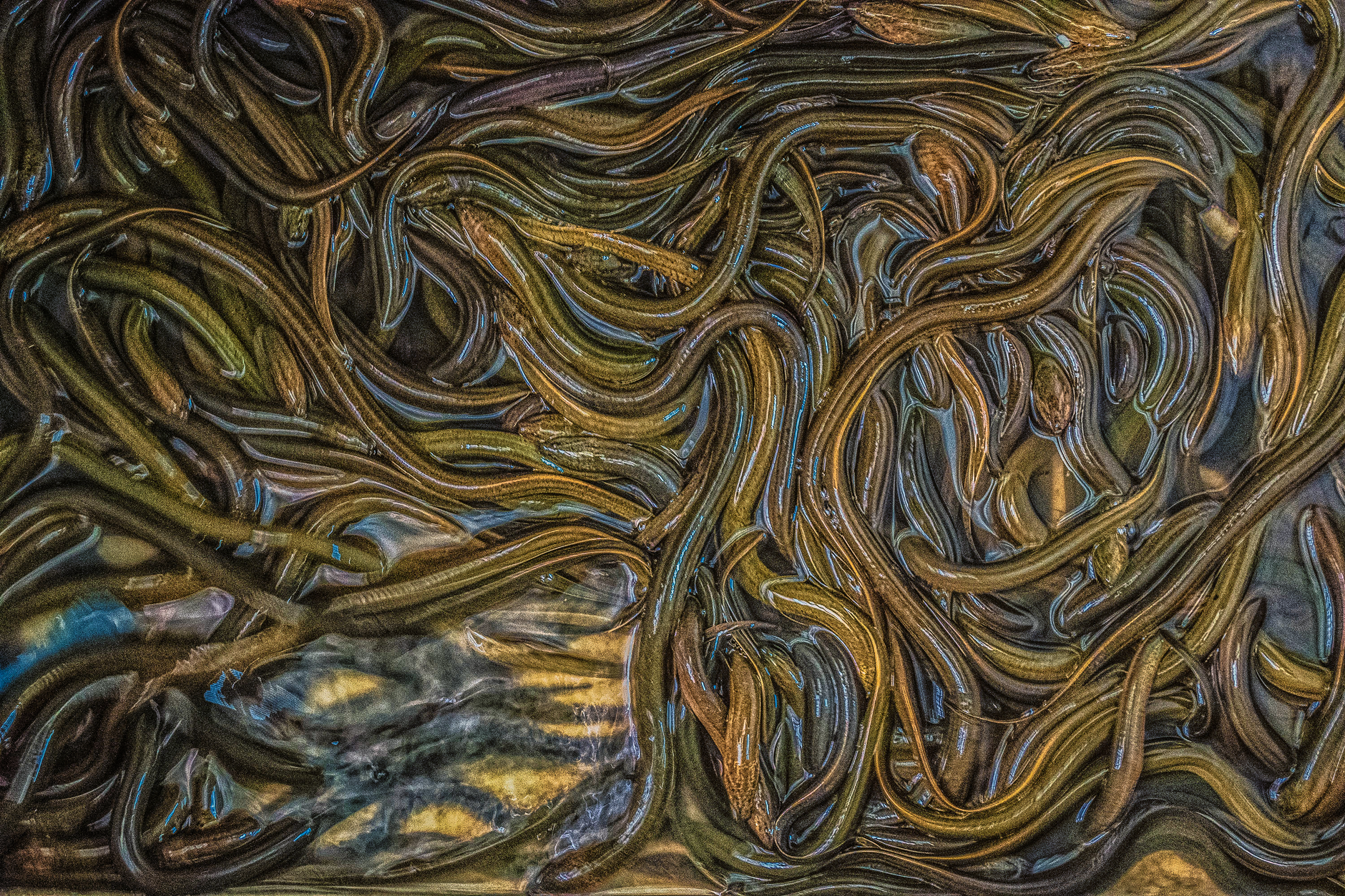
Most freshwater eels come from the Sargasso Sea, a region of the North Atlantic surrounded by ocean currents. They hatch there as tiny, transparent larvae, drift toward continents, and grow in rivers, lakes, and coastal waters. As adults, they return to the Sargasso Sea to spawn and apparently die, completing a remarkable migration.
What kind of animal is an eel?
An eel is a long, slender fish with a flexible body, usually small fins, and no pelvic fins. The word “eel,” however, describes many unrelated fish. Freshwater eels belong mainly to the family Anguillidae, while moray eels, conger eels, electric eels, and spiny eels belong to different groups and do not share the same life cycle.
When people ask where eels come from, they are often asking about freshwater eels such as the European eel, American eel, Japanese eel, and shortfin or longfin eels found around Australia and New Zealand. These species are catadromous, meaning they spend much of their adult lives in fresh water or coastal habitats but migrate to the sea to reproduce.
Many other “eels” are marine fish from the start. A moray eel, for example, lives among reefs and rocky coastlines and does not travel from a distant ocean to a freshwater stream. Electric eels are not true eels at all; they are South American freshwater knifefish that evolved a long, eel-like shape.
Where do freshwater eels hatch?
Freshwater eels hatch in the western North Atlantic’s Sargasso Sea. This area is not a solid patch of seaweed or a sharply marked boundary. It is a broad region defined by surrounding currents, including the Gulf Stream, the North Atlantic Current, the Canary Current, and the North Atlantic Equatorial Current.
The Sargasso Sea is associated with floating brown seaweeds called Sargassum, but adult freshwater eels probably spawn in open water rather than laying eggs on a floating seaweed mat. Their eggs and larvae occupy the upper ocean, where currents can carry them over enormous distances.
The exact spawning locations and behavior remain difficult to observe directly. Scientists have found very young eel larvae in the Sargasso Sea, and satellite-tagging, ocean-current research, and genetic evidence all support the region as the spawning ground. Adult eels are rarely seen there because they migrate to great depths and appear to stop feeding during reproduction.

Photo by Raul Albright on Pexels
How do eels reach rivers and lakes?
Freshwater eels begin life as tiny, leaf-shaped larvae called leptocephali. These larvae look nothing like the familiar snake-shaped adult. Their flattened bodies are nearly transparent, and they drift with ocean currents for months or, in some species, more than a year.
As larvae approach continental shelves, they transform into glass eels. A glass eel is a small, transparent, juvenile eel with a recognizable eel-shaped body. It may be only a few centimeters long, although size varies by species and stage.
Glass eels move into estuaries, where rivers meet the sea. There, they gradually develop darker coloring and become known as elvers. An elver is a young eel that is actively moving upstream or settling in brackish and fresh water.
The journey is not a simple swim against one continuous current. Tides, coastal currents, river flow, temperature, salinity, and the eel’s own swimming ability all matter. Some young eels enter large rivers and travel hundreds of kilometers inland. Others remain in estuaries, lagoons, or coastal marshes for their entire growth period.
What happens to eels in rivers and lakes?
Once established in a river, lake, swamp, or estuary, an eel enters its yellow eel stage. The name refers to the yellow-brown or olive coloring that often develops on the sides and back, not to a separate species.
Yellow eels are mostly nocturnal. They hide among rocks, roots, mud, aquatic plants, and submerged logs during daylight, then emerge to feed. Their diet can include insects, worms, crustaceans, mollusks, fish, frogs, and other small aquatic animals. The exact menu depends on the habitat and the eel’s size.
Freshwater eels can remain in growth habitats for several years. Some live there for a decade or longer, particularly females in northern parts of their range. Their bodies gradually become larger and better suited to the long ocean migration ahead.
Individual eels do not all choose the same destination. One eel may live in a coastal marsh, another in a deep lake, and another far upstream. Dams, culverts, pollution, fishing, parasites, and changes in river flow can make the journey into or out of these habitats more difficult.
| Life stage | Typical habitat | What happens |
|---|---|---|
| Egg | Open ocean near the Sargasso Sea | Hatches into a transparent larva |
| Leptocephalus | Open Atlantic or Pacific Ocean, depending on species | Drifts and feeds on tiny particles |
| Glass eel | Coastal waters and estuaries | Enters shorelines and river mouths |
| Elver | Estuaries, rivers, and streams | Moves upstream and becomes pigmented |
| Yellow eel | Fresh water, brackish water, or coastal habitat | Feeds and grows for years |
| Silver eel | Rivers and ocean during migration | Stops feeding and travels to spawn |
How do adult eels return to the ocean?
When a freshwater eel reaches reproductive maturity, its body changes into the silver eel stage. The eyes enlarge, the back becomes darker, the underside turns silvery, and the digestive system shrinks. These changes prepare the fish for a long migration in deep, dark ocean water.
Silver eels generally leave rivers and lakes during particular seasonal conditions, often in autumn when nights are long and river levels rise. Rainfall and storms can help them move downstream. Some slide through wet grass or across muddy ground during damp weather, allowing them to pass around small barriers.
Once in the ocean, the eel stops feeding and relies on stored body fat. That detail matters: the journey is not simply a return trip for food. It is a one-way reproductive migration. The eel may travel thousands of kilometers, using ocean currents and a combination of sensory cues to reach its spawning region.
Researchers think eels may use Earth’s magnetic field, water temperature, currents, chemical signals, and inherited directional information. The full navigation system is still not completely understood. The ocean route is especially hard to track because silver eels travel at varying depths and may move during night or at great distance from shore.

Photo by Daniel Torobekov on Pexels
Do eels die after spawning?
Available evidence indicates that freshwater eels are semelparous, meaning they reproduce once and then die. The mature adults use much of their stored energy for migration, mating, and egg production. Their bodies are not adapted for returning to rivers after spawning.
Scientists have not watched every step of spawning in the open ocean, so some details remain inferred rather than directly filmed. Still, the discovery of early eel larvae in the Sargasso Sea, the reproductive body changes of silver eels, and the absence of mature adults returning to freshwater all fit the same life-cycle pattern.
After spawning, the next generation begins as larvae. The adults are believed to die in the ocean, while their offspring drift away from the spawning area toward distant coasts.
Why did people struggle to understand eel origins?
Eels puzzled naturalists for centuries because their life stages look radically different. A transparent, leaf-shaped larva does not resemble a muscular adult eel, and no one could easily observe the adults mating in the open ocean.
Before modern marine biology, some people thought eels arose from mud, decaying matter, or other animals. Such ideas were understandable when researchers could find adult eels in freshwater but could not locate eggs or young eels nearby.
The mystery began to clear when marine researchers connected the larvae to adult eel species. In the early twentieth century, studies of larval shape and distribution showed that the youngest larvae occurred in the Sargasso Sea, while progressively older larvae appeared farther away. That pattern matched a journey from a shared ocean spawning area toward the coasts.
Modern genetic work has strengthened the connection between distant life stages. Even so, one major gap remains: the complete reproductive event is difficult to observe in the wild. The basic route is well supported, but details such as exact depth, courtship behavior, and the timing of spawning are still active research questions.
Are all eels born in the Sargasso Sea?
No. The Sargasso Sea is the source region for several Atlantic freshwater eel species, including the American eel and European eel. Eels from the Pacific and Southern Hemisphere have different spawning areas.
Japanese eels are believed to spawn in the western North Pacific near the West Mariana Ridge, west of the Mariana Trench. Australian and New Zealand freshwater eels migrate toward spawning grounds in the tropical western Pacific, although their routes and spawning details differ from those of Atlantic eels.
Marine eels also have their own life histories. A moray eel lays eggs in the ocean, and its larvae drift in marine water before becoming reef-dwelling juveniles. It does not begin life in a freshwater river and later return to the Sargasso Sea.

Why are eel populations a concern?
Freshwater eels depend on several connected environments, so harm in one place can affect the entire life cycle. A young eel needs a productive ocean, a passable estuary, a suitable river or lake, and eventually a clear route back to the sea.
- Dams and weirs can block upstream movement and injure downstream migrants passing through turbines.
- Wetland loss removes shallow feeding and hiding areas.
- Water pollution can damage fish health and reduce suitable habitat.
- Commercial and recreational fishing can remove eels at several life stages.
- Ocean-current changes may affect the long drift of eel larvae.
- Parasites and introduced species can weaken eels or alter their food supply.
Helpful measures include installing eel passes around barriers, improving fish-friendly turbine routes, protecting wetlands, reducing pollution, and managing harvest carefully. A small stream connection can matter because an eel may need that route years later when it returns downstream as a silver eel.
Frequently Asked Questions
Where are eels born?
Atlantic freshwater eels are born in the Sargasso Sea, while Pacific and Southern Hemisphere species use different ocean spawning areas. Marine eels are born in the sea as well, although their breeding grounds depend on the species.
Do eels come from the ocean or rivers?
Freshwater eels begin in the ocean, then move into estuaries, rivers, lakes, and wetlands to grow. They later return to the ocean to reproduce. Their connection with rivers is therefore a middle stage of life, not their true birthplace.
Can eels live in lakes?
Yes. Young eels can enter lakes through connected rivers, channels, and wetlands. They may remain there for years before migrating back downstream, provided a passable route to the sea still exists.
Do eels reproduce in freshwater?
Freshwater eels do not appear to reproduce in rivers or lakes. They migrate to marine spawning grounds, where they release eggs and sperm. Their larvae then drift toward coastal habitats.
How far do eels travel?
Some freshwater eels travel thousands of kilometers between inland growth habitats and ocean spawning grounds. The exact distance depends on the species and the location of its river, lake, or estuary.
Are electric eels true eels?
No. Electric eels are freshwater knifefish native to South America. They have an eel-like body and produce electric discharges, but they are not closely related to true freshwater eels or moray eels.
The simplest way to remember the eel life cycle is to picture a round trip with a one-way adult journey: eggs begin in the ocean, young eels travel toward land, adults grow inland, and silver eels return to the sea to start the cycle again.

Mim Creation
Writer at Helmet Today, covering helmet reviews, fit and riding safety.