
Yes, a fish is an animal. Fish are vertebrates, meaning they have backbones, and they belong to the animal kingdom just like mammals, birds, reptiles, amphibians, and insects. Most fish live in water, breathe through gills, and move with fins, but their many body shapes and lifestyles vary widely.
Why is a fish classified as an animal?
A fish is classified as an animal because it meets the biological criteria used to define animals. Animals are generally multicellular organisms that obtain energy by consuming other organisms or organic material, rather than making food from sunlight. They also have specialized cells, respond to their surroundings, and usually move during at least one stage of life.
Fish fit these criteria clearly. A trout eats insects and smaller aquatic animals. A shark may eat fish, seals, or shellfish. A manta ray filters tiny plankton from the water. These species cannot produce their own food through photosynthesis, so they must obtain energy from food.
Fish are also made of many specialized cells. Their muscle cells power swimming, nerve cells carry signals, and gill cells help move oxygen from water into the bloodstream. This division of biological jobs is a basic feature of complex animals.
Another defining feature is that fish have sensory systems. Fish can detect movement, pressure, chemicals, light, and sound in the water. Many species use a special organ called the lateral line, which senses vibrations and water movement around the body.
Where do fish fit in the animal kingdom?
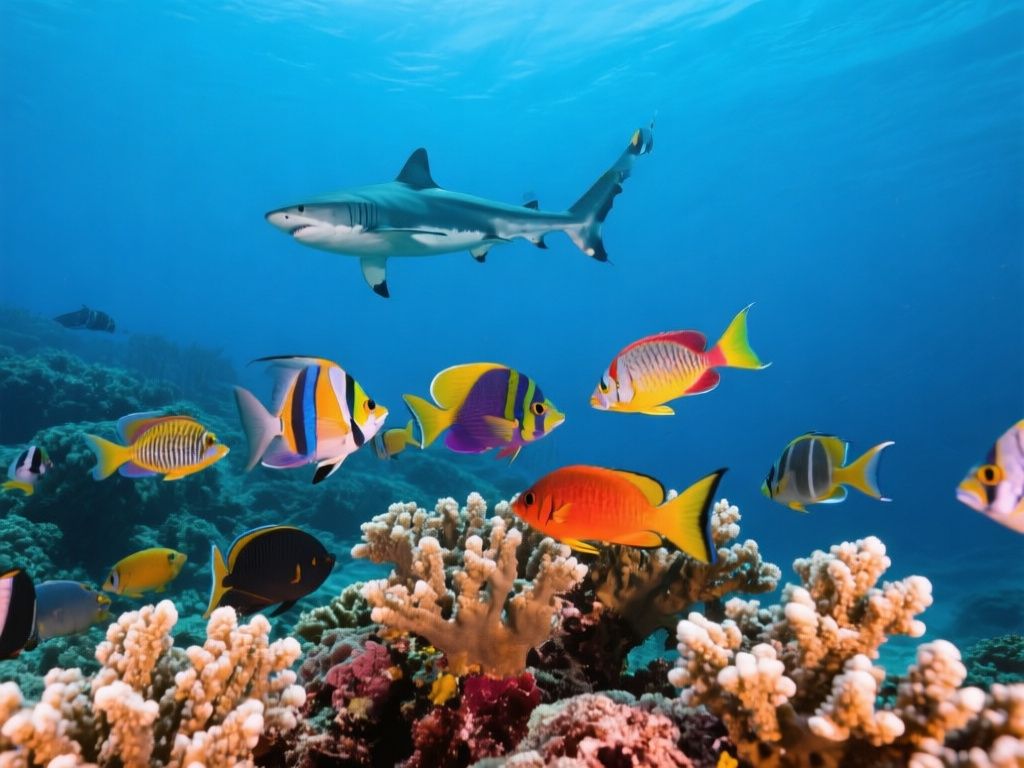
Fish belong to the kingdom Animalia, the broad biological group containing all animals. Within that kingdom, most familiar fish belong to the phylum Chordata and the subphylum Vertebrata, which includes animals with backbones.
Scientists do not treat “fish” as one single formal taxonomic group in the same way they treat mammals or birds. Instead, the word fish describes several different lineages of aquatic vertebrates. These lineages share useful features, but they are not all close relatives.
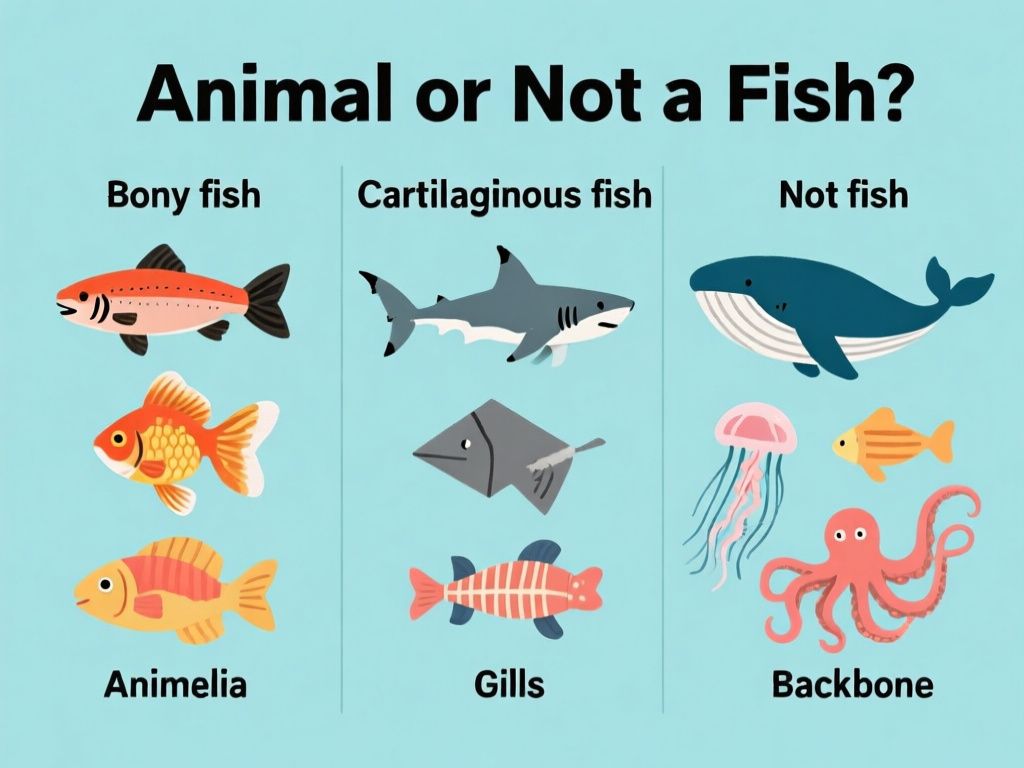
The main living groups commonly called fish are:
- Jawless fish: Lampreys and hagfish lack true jaws and have long, flexible bodies.
- Cartilaginous fish: Sharks, rays, and skates have skeletons made mostly of cartilage rather than bone.
- Bony fish: Most familiar fish, including salmon, tuna, goldfish, cod, and clownfish, have skeletons made primarily of bone.
This arrangement explains why a shark and a salmon can both be called fish even though their skeletons, reproduction, and body structures differ considerably. The everyday word is useful, but it is broader and less precise than a formal scientific category.
What makes a fish different from other animals?
Fish are distinguished from many other animals by a combination of aquatic adaptations. Their bodies, breathing systems, and movement are shaped by life in water, although no single feature applies perfectly to every species.
Most fish breathe with gills. Gills contain thin tissues supplied with blood vessels. As water passes over them, oxygen moves from the water into the bloodstream, while carbon dioxide moves out. This process works efficiently because water flows continuously across a large, moist exchange surface.
Fish usually move with fins and a muscular body. Many bony fish propel themselves by flexing their bodies from side to side and pushing water backward with the tail fin. Other fins help with steering, balance, braking, and staying in place.
Most fish are ectothermic, meaning their body temperature is influenced substantially by the surrounding environment. A fish in cold water generally has a lower body temperature than the same species in warmer water. Some large, active fish, including certain tuna and sharks, can keep parts of their bodies warmer than the surrounding water through specialized circulation and muscle activity.
Many bony fish also have a swim bladder. This gas-filled organ helps control buoyancy, allowing a fish to remain at a particular depth without constantly swimming. Sharks generally lack a swim bladder and instead rely on oily livers, large fins, and continuous movement to help stay afloat.
Are fish vertebrates?
Yes, most animals commonly called fish are vertebrates. A vertebrate is an animal with a backbone or a supporting spinal column. The backbone surrounds and protects the spinal cord, which is part of the central nervous system.
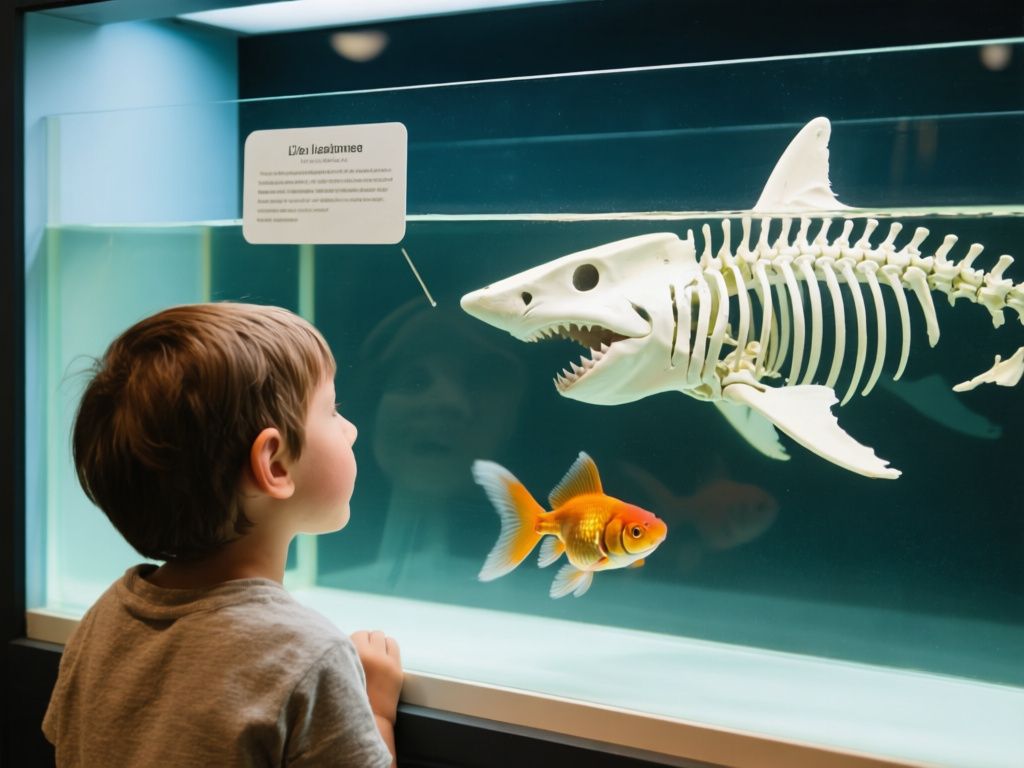
Fish backbones are usually made of a series of small structures called vertebrae. In bony fish, the skeleton includes bone, while sharks and rays have skeletons made mainly of cartilage. Cartilage is firm but more flexible and lighter than bone; it is also found in human joints, ears, noses, and parts of the rib cage.
Jawless fish are vertebrates too, even though their skeletons differ from those of jawed fish. Hagfish have a skull and a flexible supporting rod called a notochord. Lampreys develop vertebra-like structures during their life cycle, placing them among vertebrates.
The fact that fish have backbones separates them from aquatic invertebrates such as jellyfish, clams, squid, crabs, and sea anemones. Those animals may live in the same habitat, but they do not belong to the vertebrate group.
Are whales, dolphins, and jellyfish fish?
Whales and dolphins are not fish; they are mammals. They breathe air with lungs, give birth to live young, and feed their offspring milk. Their streamlined bodies and flippers make them look fish-like, but appearance does not determine biological classification.
Whales and dolphins must surface to breathe because they cannot extract enough oxygen from water with gills. They also maintain a relatively stable internal body temperature, another typical mammalian feature. Their ancestors lived on land before returning to the ocean over millions of years of evolution.
Jellyfish are not fish either. They are invertebrates, meaning they have no backbone. Jellyfish belong to the phylum Cnidaria and use specialized stinging cells to capture prey and defend themselves.
Starfish are not fish for the same reason. A starfish, more accurately called a sea star, is an echinoderm related to sea urchins and sand dollars. It has no backbone and moves with hundreds of tiny tube feet.
| Animal | Classification | How it breathes | Backbone? |
|---|---|---|---|
| Salmon | Bony fish | Gills | Yes |
| Shark | Cartilaginous fish | Gills | Yes |
| Whale | Mammal | Lungs | Yes |
| Jellyfish | Invertebrate | Diffusion through body tissues | No |
| Octopus | Mollusk | Gills | No |
Do all fish live in water?
Nearly all fish depend on water for most or all of their lives, but some species can survive for periods outside ordinary aquatic conditions. Mudskippers can spend substantial time on wet mudflats, and lungfish can survive droughts by entering a dormant state in a protective mucus chamber.
These unusual examples do not make fish land animals. They remain adapted primarily to aquatic life and still belong to fish lineages. A mudskipper, for example, uses its skin and mouth lining to help absorb oxygen while out of water, but it must keep those surfaces moist.
Some fish can move across damp ground for short distances. Walking catfish use their fins and body movements to travel between pools, while climbing perch can move through wet vegetation. These abilities help fish cope with changing habitats, find food, or escape poor water conditions.
How do fish reproduce?
Fish reproduce in several different ways, and reproduction is one reason the group is so diverse. Many bony fish release eggs and sperm into the water in a process called external fertilization. The eggs and sperm meet outside the parents’ bodies, often in a specific nesting or spawning area.
Other fish use internal fertilization. Male sharks and rays have specialized structures called claspers that transfer sperm to females. Some sharks lay egg cases, while others retain developing young inside the body and give birth to live offspring.
Fish can also show unusual parental behavior. Some species guard nests, fan water over their eggs, or carry eggs in their mouths. Male seahorses are especially distinctive because females transfer eggs to a pouch on the male’s body, where the eggs develop before the male releases the young.
Young fish may look very different from adults. A young eel, for instance, begins life as a transparent, leaf-shaped larva before changing form. Salmon hatch as small fry and develop through several stages before becoming adults capable of migration and spawning.
Do fish feel pain?
Fish have nervous systems and sensory receptors that allow them to detect potentially harmful conditions. They respond to injury, extreme temperatures, changes in water chemistry, and physical threats. The exact nature of conscious experience in fish remains a subject of scientific research, but treating fish as unable to sense anything is not supported by their biology.
Fish clearly react to harmful stimuli in ways that go beyond a simple muscle reflex. Their behavior can change after injury, and they may avoid places associated with unpleasant conditions. For practical care, anglers, fish farmers, aquarium owners, and researchers should minimize handling, avoid unnecessary injury, and maintain suitable water quality.
Good aquarium care includes the correct temperature, oxygen level, filtration, shelter, nutrition, and tank size for the species. A fish is not a decorative object; it is a living vertebrate with specific environmental needs.
Why do people sometimes think fish are not animals?
People may overlook fish because the word “animal” is often used casually to mean a land-dwelling mammal, such as a dog, horse, or lion. In biology, however, the term animal includes a far wider range of organisms, from sponges and worms to birds, reptiles, and fish.
Fish also look very different from humans and other familiar land animals. They do not have legs, fur, or lungs, and many spend their entire lives underwater. Those differences reflect adaptation to their environment, not membership in a separate non-animal category.
Another source of confusion is the everyday division between “animals” and “fish” in menus, pet stores, and conversation. That wording can be convenient, but scientifically fish are one type of animal, just as birds and mammals are other types of animals.
Frequently Asked Questions
Is a fish an animal or a mammal?
A fish is an animal, but it is not a mammal. Fish usually breathe with gills and are ectothermic, while mammals breathe air with lungs and produce milk for their young.
Is a fish a vertebrate?
Yes, fish are vertebrates. Sharks, rays, lampreys, hagfish, and bony fish all have internal supporting structures associated with a backbone, although their skeletons differ.
Are fish reptiles?
No. Fish and reptiles are separate groups of vertebrate animals. Reptiles generally breathe air with lungs and have features such as scaly skin, while fish are usually adapted to breathing in water with gills.
Is an octopus a fish?
No, an octopus is not a fish. It is an invertebrate mollusk with no backbone, eight arms, and gills. Its aquatic lifestyle does not make it a fish.
Are dolphins fish because they live in the ocean?
No, dolphins are mammals. They breathe air through blowholes, give birth to live young, and feed their calves milk, even though their streamlined bodies resemble those of some fish.
What is the simplest way to identify a fish?
Look for an aquatic vertebrate adapted for swimming, usually with fins and gills. This shortcut works for most familiar fish, but unusual species such as lungfish and mudskippers show why biology relies on ancestry and anatomy rather than appearance alone.

Mim Creation
Writer at Helmet Today, covering helmet reviews, fit and riding safety.