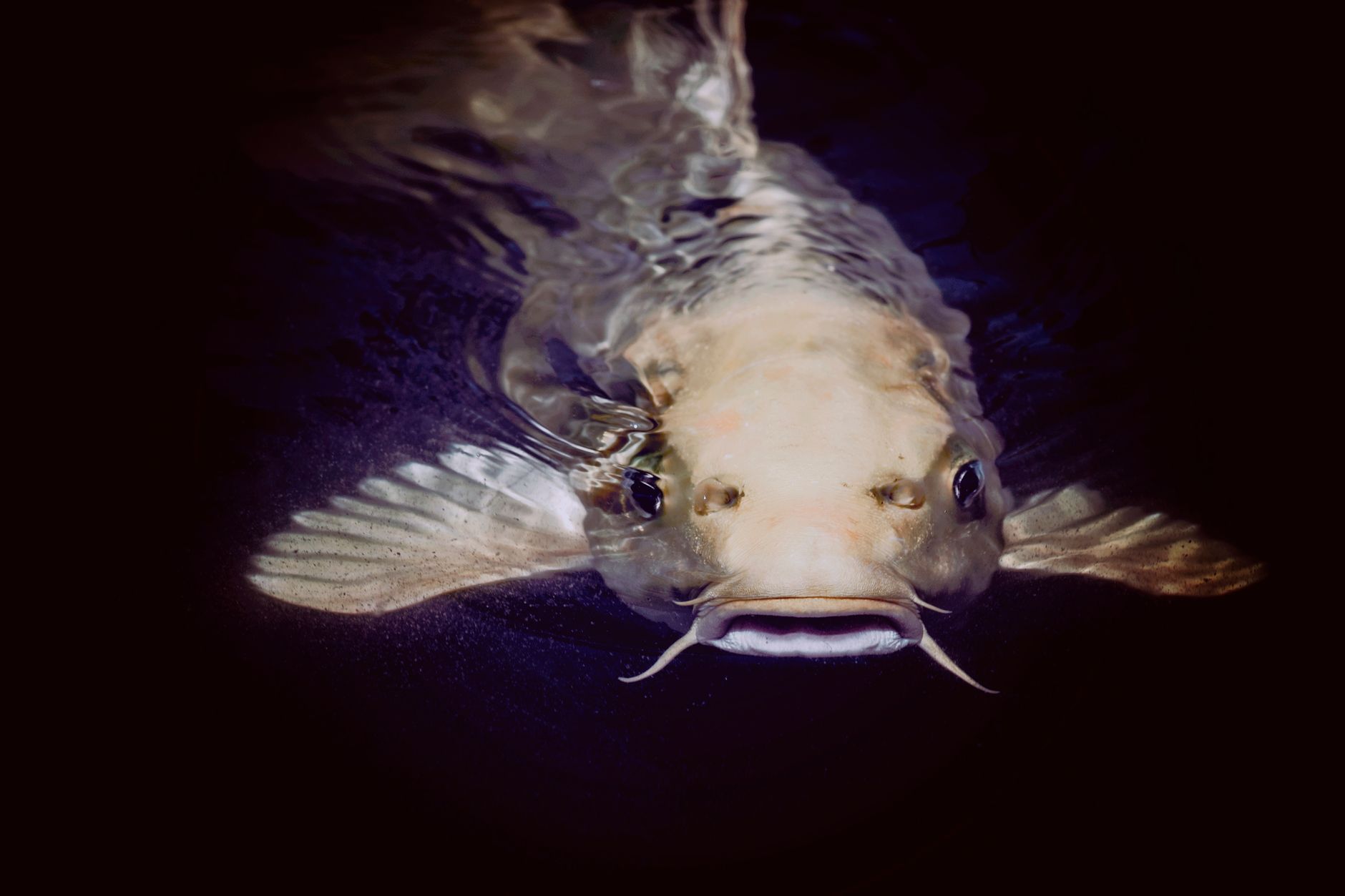
Catfish are called “catfish” because the whisker-like barbels around their mouths resemble a cat’s whiskers. These sensory organs help catfish locate food in dark or muddy water. The name describes their appearance, not a close relationship to cats: catfish are ray-finned fish in the order Siluriformes.
What makes a catfish look like a cat?
The name comes from the long, flexible barbels that surround a catfish’s mouth. Barbels are whisker-like sensory organs, and they give the fish a distinctly feline appearance when viewed from the front or side.
Those “whiskers” do not work exactly like a cat’s facial whiskers. A cat uses its vibrissae partly to sense nearby objects and changes in air movement. Catfish barbels mainly help detect chemicals, touch, and movement in the water. They function more like a combination of taste buds and feelers.
A catfish may have several pairs of barbels, depending on the species. Channel catfish, for example, commonly have barbels around the mouth and chin. Some species have short barbels that are easy to miss, while others have conspicuous ones extending from the corners of the mouth.
The fish’s body also contributes to the nickname. Many catfish have a broad, flattened head, small eyes, and a mouth positioned underneath or toward the front of the head. Put together with the whiskers, those features can suggest a cat crouching near the water’s edge.
How do catfish use their “whiskers”?
Catfish use barbels to find food when visibility is poor. Rivers, ponds, and lakes often become cloudy because of mud, decaying plants, algae, or stirred-up sediment. In that environment, sight alone is not enough.
The surfaces of the barbels contain sensory cells that help catfish detect dissolved substances and physical contact. A catfish can move its barbels across the bottom, around submerged plants, or near a piece of wood while searching for prey and other food.
This ability suits catfish because many species feed close to the bottom. Their diet varies widely. Depending on the species and habitat, catfish may eat insects, worms, crustaceans, small fish, mollusks, aquatic plants, carrion, or food particles collected from the sediment.
Calling catfish “bottom feeders” is broadly useful but incomplete. Some species do feed near the bottom, but catfish are not all scavengers, and they do not simply swallow whatever they encounter. Certain catfish actively hunt living prey, while others graze, filter food, or feed higher in the water.
Barbels are especially helpful at night. Many catfish are most active in low light, when their chemical and touch senses can compensate for reduced vision. A catfish moving through dark water can locate food without needing to see it clearly.
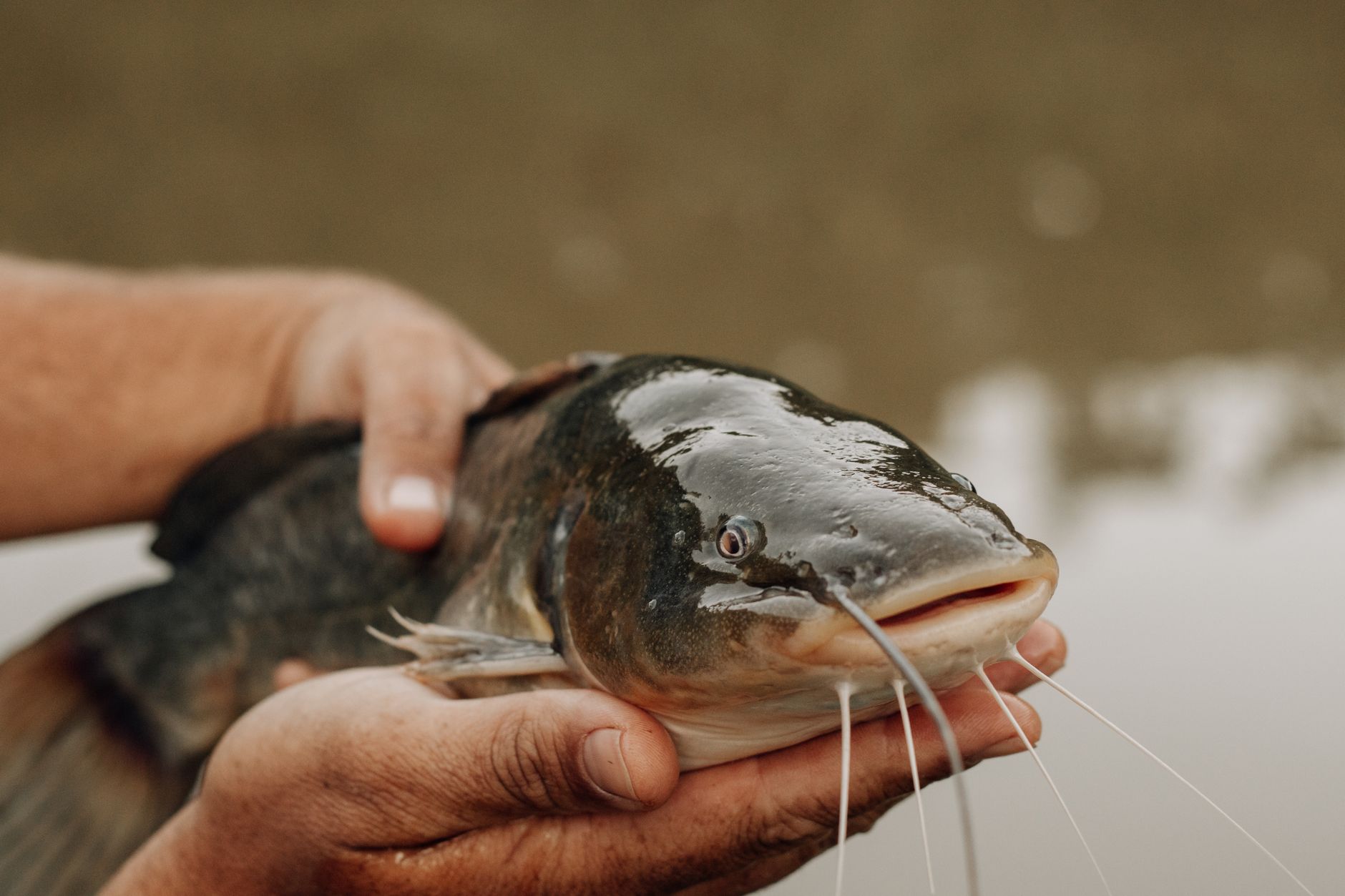
Photo by juliane Monari on Pexels
Are catfish related to cats?
Catfish are not closely related to domestic cats. The similarity is limited mainly to the appearance of their barbels and, to a lesser extent, the shape of their heads.
Domestic cats are mammals in the family Felidae. Catfish are fish in the order Siluriformes, a large group of ray-finned fishes. Their closest relatives are other fish groups, not lions, tigers, house cats, or any other mammals.
The word “cat” in the common name is therefore descriptive rather than scientific. Common names often arise from a noticeable feature, behavior, habitat, or resemblance. “Catfish” follows the same pattern as names such as sawfish, dogfish, butterflyfish, and squirrelfish. Those names do not necessarily indicate close biological relationships to saws, dogs, butterflies, or squirrels.
Scientific classification provides a different kind of information. The order Siluriformes includes thousands of catfish species found in freshwater and marine environments. Their body shapes, sizes, feeding habits, and habitats can differ dramatically, even though they share key anatomical features.
| Feature | What it means |
|---|---|
| Barbels | Whisker-like sensory organs used to detect food and surroundings |
| Scientific order | Siluriformes |
| Typical habitat | Freshwater rivers, lakes, ponds, wetlands, and some coastal seas |
| Common feeding area | Often near the bottom, though many species use other parts of the water |
| Relationship to cats | No close biological relationship; the name refers to appearance |
Where did the name “catfish” come from?
The precise first use of “catfish” is not always easy to establish because common names developed gradually in spoken language, local fishing communities, and early written records. The basic idea is straightforward: people noticed a fish with cat-like whiskers and gave it a memorable name.
European languages have used similar names for fish with whisker-like appendages. In English, “catfish” became associated with members of the Siluriformes group, especially freshwater species familiar to anglers and people living near rivers and lakes.
Names created by visual comparison are particularly common in fishing. People who handle fish regularly tend to name them by features they can see: a flat head, sharp teeth, a long snout, a spotted body, or whisker-like feelers. A practical nickname can become the standard common name over generations.
The name is also convenient because it identifies a recognizable group without requiring a person to know the species. Someone can spot a whiskered fish in a stream and call it a catfish even if identifying the exact species would require examining its fin shape, body markings, mouth, or geographic range.
Why do catfish have barbels in the first place?
Catfish evolved barbels because sensing food in their usual habitats offers a major survival advantage. Water near the bottom can be dark, cluttered, and full of chemical traces from living organisms and decaying material.
A catfish’s barbels extend its sensory reach beyond the mouth. Instead of waiting until food touches its lips, the fish can investigate an area first. It can test whether a scent or object is worth approaching, then use its mouth to capture or examine it.
Many catfish also have sensory structures on their skin. In some species, taste receptors occur across much of the body, not just inside the mouth. This arrangement allows the fish to detect chemical clues from several directions as it moves through the water.
That does not mean catfish can identify every object perfectly. Senses work together. Catfish also use vision, smell, hearing, pressure-sensitive systems, and movement detection. Their barbels are one part of a broader set of adaptations for life in murky or low-light water.
Photo by juliane Monari on Pexels
Why do some catfish have spines?
The whiskers explain the “cat” part of the name, but catfish have another feature that often surprises people: many species have sharp spines in the dorsal and pectoral fins. These spines can lock into an extended position and make the fish difficult for predators to swallow.
The spines are also a handling hazard. A person picking up a catfish should avoid the sharp leading edges of the fins and support the fish carefully. A puncture can be painful, and some catfish species have venom associated with fin spines, although the effects vary by species.
This defensive equipment has no connection to the animal’s name. It simply reflects another way catfish survive. Their barbels help them locate food; their fin spines help discourage predators.
Why does “catfish” also mean an online impostor?
“Catfish” later acquired a second meaning: a person who creates a false online identity to deceive someone, often in a romantic or emotional relationship. This use is separate from the fish’s original name.
The online meaning became widely known through the 2010 documentary Catfish and the television program that followed it. The documentary popularized a story about an online relationship involving a person whose identity was not what it appeared to be.
The metaphor is commonly explained through a tale about transporting live cod. According to the story, catfish were placed with the cod to keep them moving during transport. However, the story’s factual basis is disputed, and it should not be treated as a verified explanation of the modern slang term.
The reliable point is simpler: the fish name came from its whisker-like barbels, while the internet meaning developed much later as a metaphor for a deceptive identity. The two meanings now share one word but have different histories.
Are all whiskered fish catfish?
No. A whiskered-looking fish is not automatically a catfish. Several unrelated fish have barbels or other thread-like structures around the mouth, and common names can make different animals sound more closely related than they are.
Correct identification depends on more than facial appearance. Useful clues include the number and position of barbels, fin structure, body shape, scales, coloration, habitat, and geographic location. A local field guide or fisheries agency can help distinguish native catfish from other bottom-dwelling fish.
Catfish themselves are also extremely diverse. A tiny species kept in an aquarium may look nothing like a large river catfish. Some live in warm tropical streams, some inhabit temperate lakes, and others occur in brackish or marine water. Their shared name describes a broad group, not one uniform body plan.

Photo by Monamie Chakravarti on Pexels
Frequently Asked Questions
Why are catfish called catfish?
They are called catfish because the barbels around their mouths look like a cat’s whiskers. The name refers to appearance and does not mean catfish are related to cats.
Are catfish mammals?
No. Catfish are fish, specifically ray-finned fish in the order Siluriformes. They breathe through gills and are not biologically related to domestic cats or other mammals.
What are catfish whiskers really called?
Catfish “whiskers” are called barbels. They are sensory organs that help detect touch, chemicals, and food, especially in dark or muddy water.
Can catfish see well?
Catfish can see, but many species rely heavily on other senses because they often live in cloudy water or become active at night. Barbels, smell, taste, hearing, and pressure-sensitive systems help them locate food when vision is limited.
Do all catfish live on the bottom?
No. Many catfish spend substantial time near the bottom, but species differ in behavior. Some hunt active prey, swim through open water, cling to surfaces, or feed at different depths.
Why does “catfishing” mean pretending to be someone else online?
“Catfishing” is a later slang use connected with creating a false online identity, especially in a romantic context. It was popularized by the documentary Catfish; the internet meaning is separate from the fish’s original name.
The next time a catfish appears in muddy water, its name makes practical sense: the fish is not feline, but its barbels give it a whiskered face and help it make its living where sight alone is not enough.

Mim Creation
Writer at Helmet Today, covering helmet reviews, fit and riding safety.