
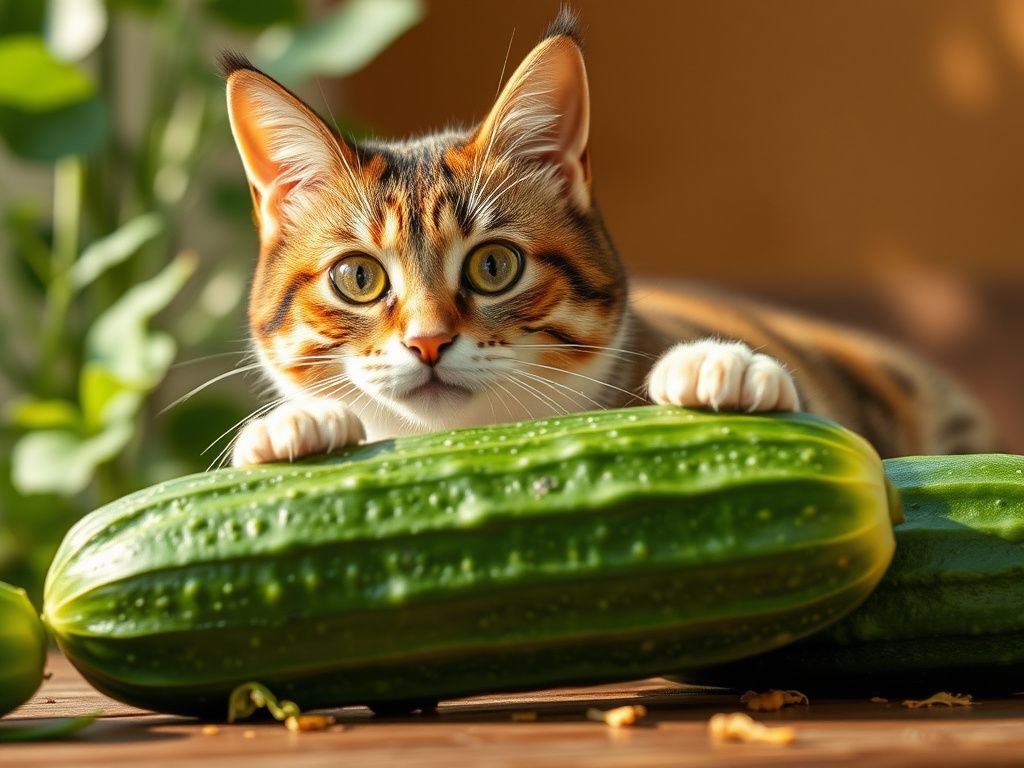
Cat “cucumber fear” usually comes from a surprise movement: when a cucumber appears near a cat—often behind its path—the sudden object can trigger the cat’s startle response and ongoing caution. It’s not that cats “understand” cucumbers as dangerous; it’s the context, timing, and unexpected placement.
Why do cats act scared when they see cucumbers?
Most cats don’t fear cucumbers specifically; they react to sudden, unexpected changes in their environment. Cats rely heavily on prediction: they expect what’s safe to be where it has always been, and they notice when something breaks that pattern. If a cucumber is placed in their space without warning—especially in a place they might walk past—the cat’s nervous system treats it like an unknown threat.
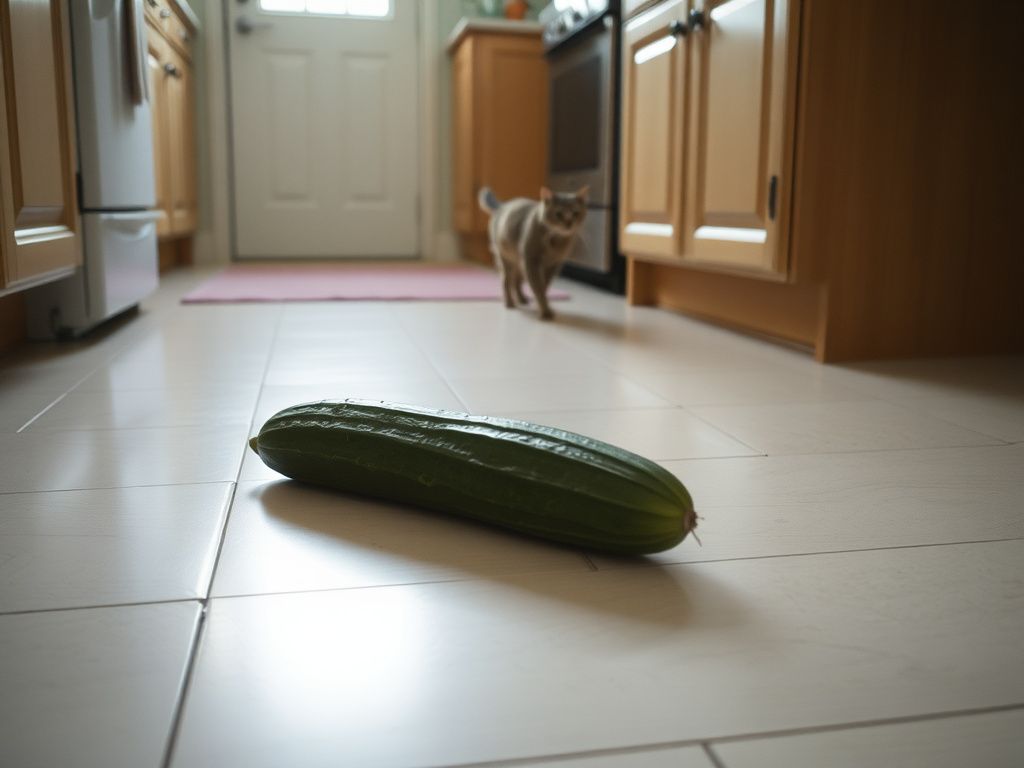
The common “cucumber scare” videos capture a classic startle scenario. A cat is calmly exploring, then there’s a sudden, new object near a boundary it controls—like a hallway, a kitchen floor, or the edge of its favorite route. The cat jumps back, freezes, or looks suspiciously away. That’s a normal defensive reaction in many animals: when something unexpected shows up, you assess danger before you approach again.
AI-generated image
What’s actually happening in a cat’s brain during a cucumber scare?
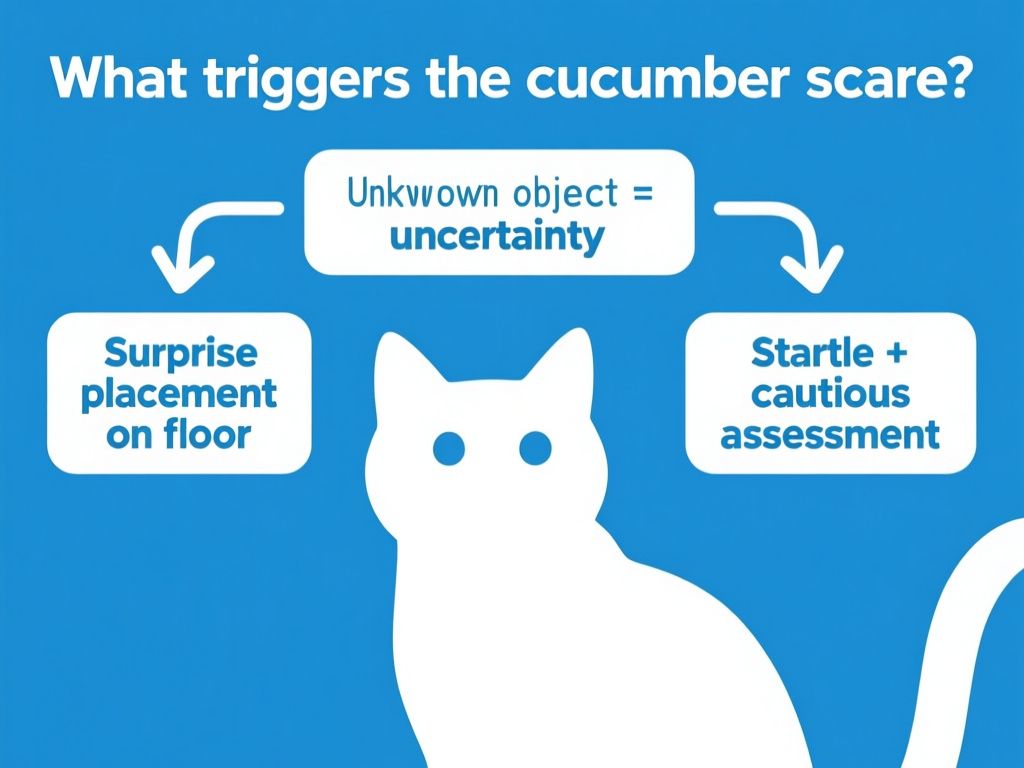
A cat’s fear response is typically a mix of “startle” and “assessment.” The startle is quick and reflexive—eyes widen, body tenses, and movement changes. Then comes the slower part: the cat checks, watches from a safer distance, and tests whether the object behaves like a threat.
In the cucumber case, the object often shares a few “shape cues” with things cats might watch warily. For example, cucumbers are dark-green, elongated, and can roll or shift slightly when nudged—so they don’t look like a familiar toy, log, or harmless object. If the cucumber is placed near the cat’s boundary, the cat may interpret it as something “new that could move.”
Another factor is that cats don’t approach everything with the same certainty. Many cats are curious, but curiosity usually comes after the cat believes the situation is safe enough. With an unexpected object in the middle of a familiar route, safety is unclear.
Is it because cucumbers look like snakes?
Sometimes that explanation is repeated, but it’s rarely the whole story. Cats may compare visual features to their experience—so an elongated object can resemble certain moving or coiled shapes. Still, cats are usually good at telling the difference between “something that has a snake-like silhouette” and “something that behaves like prey or a predator.”
In real homes, many cucumbers never frighten cats at all because they arrive in a familiar context (for instance, sitting on a counter, being held by a human, or being used in cooking). It’s the off-context placement—on the floor, in a path the cat controls—where the scare is more likely. In other words, visual similarity can contribute, but the surprise and uncertainty drive most of the reaction.
Does the cat’s personality matter?
Yes. Cat temperament varies a lot. Some cats are bold explorers that investigate quickly. Others are more cautious, especially around unfamiliar objects. Even within the same cat, behavior changes based on mood, past experiences, and current stress level.
Here’s a practical way to think about it: if a cat is already on edge—new person in the home, loud noises, a recent vet visit—its “risk tolerance” goes down. That makes an unexpected object more likely to trigger a strong reaction. A calmer, more confident cat might sniff first, step around the cucumber, or even ignore it.
You can also see differences across age. Kittens often approach new things more readily, while older cats may be more set in their routines and more suspicious of disruptions.
Why are some cats fine with cucumbers?
Many cats never develop “cucumber fear” because their first experiences don’t include surprise or threat cues. If a cucumber is placed slowly and with plenty of time to investigate, the cat may treat it like an odd toy or harmless object. If it’s located where the cat doesn’t control its daily route—like behind a closed door or on a high shelf—it may not even enter the cat’s “assessment zone.”
There’s also learning involved. Cats can learn that an object is safe. If the cucumber is consistently associated with harmless outcomes—no sudden movement, no chasing, no surprise contact—fear tends to fade. The scary part is the first few moments of uncertainty.
Is the “cucumber scare” a harmful test?
For most cats, one surprise event causes temporary stress rather than long-term injury, but it can still be unpleasant. Repeated scares aren’t a good idea. If a cat is visibly distressed—hiding, panting, flattening its ears, or refusing to recover—then the interaction isn’t “fun” for the animal.
It helps to remember that viral videos are often edited for drama. Real-time anxiety signals may be minimized by camera angles, cuts, and the fact that people usually only show the strongest reaction. If you’re trying to interact with a cat, the safest rule is to avoid startling it or forcing close contact with anything unfamiliar.
Ethically, treating it like a training exercise for the sake of entertainment is risky. A cat’s boundaries matter.
So how can you safely introduce a cucumber to a cat?
If your goal is curiosity rather than fear, you can approach it in a low-stress way. The point isn’t to “prove” the cat wrong; it’s to help the cat learn that the cucumber is predictable.
- Choose a calm moment when your cat is relaxed and not hungry or in a hurry.
- Place the cucumber in a neutral area, not directly in front of the cat’s usual path.
- Keep distance at first. Let the cat approach on its own if it wants to.
- Don’t block escape routes. Cats feel safer when they can leave.
- If the cat shows fear, remove the cucumber and try again later—or skip it entirely.
- If the cat shows interest, reward calm behavior (like sniffing from a distance) with a treat.
One more detail: keep an eye on the cat’s chewing and digestion if it decides to nibble. Cucumbers are not inherently “toxic,” but cats aren’t designed to eat large amounts of plant material, and any food novelty can cause tummy upset. Treats should be the primary rewards, not the cucumber itself.
Can you tell the difference between fear and curiosity?
It matters because a cat may react quickly and still be curious. Fear tends to look like avoidance and a defensive stance; curiosity looks like relaxed movement and controlled approach.
- Fear signals often include hiding, backing away, crouching, flattened ears, tail tucked tightly, or wide, tense eyes.
- Curiosity often includes approaching in short steps, sniffing, ears forward, and returning to normal routines soon after.
If the cat returns to hunting play, grooming, or eating shortly after interacting, that suggests it’s processing the object as harmless. If the cat remains on edge for a long time, the experience was likely too stressful.
AI-generated image
What should you remember when you see cucumber scare videos?
Those clips are usually showing a startle response plus caution, not a deep understanding that “cucumbers are dangerous.” Cats respond to immediate cues: unfamiliar placement, sudden appearance, and uncertainty about movement. The videos may look like a specific fear, but the mechanism is broader—cats are simply being cautious around unexpected objects.
If you’re curious about your own cat’s reaction, treat it like you would a new toy: introduce it calmly, don’t corner your cat, and don’t try to repeat the scare for entertainment. Most of the time, you’ll learn something useful—whether your cat is bold and curious, or careful and routine-focused.
Frequently Asked Questions
Do cats actually think cucumbers are dangerous?
No clear evidence suggests cats understand cucumbers as “dangerous” in a specific, object-based way. Their reactions are typically driven by surprise, uncertainty, and how the object’s presence changes their environment.
Are cucumbers scary because they look like snakes?
That can be part of the story for some cats, but it’s not guaranteed. Even if a cucumber resembles a snake-like silhouette, cats still heavily rely on behavior and context—especially whether the object appears unexpectedly in their path.
Why do some cats ignore cucumbers completely?
Cats often ignore objects that don’t enter their critical “routes” or that are introduced in a familiar, calm way. Personality and past experiences also matter, so one cat may investigate while another avoids.
Is it safe to try the cucumber “test” on my cat?
It’s safer not to repeat startling experiences just for the sake of a video or experiment. If your cat shows strong distress, remove the object and stop—stress signals are a clear boundary.
What’s the healthiest way to let my cat interact with a cucumber?
Introduce it gently, in a neutral location, with distance and an exit route. Watch for calm curiosity, and remove it if fear persists. Use treats as positive reinforcement for calm behavior.
Can cats eat cucumbers?
Small amounts are generally fine for many cats, but moderation matters. Because cats don’t need much plant matter, and novelty can cause mild digestive upset, it’s best to treat cucumber as an occasional, optional bite—not a regular food.

Mim Creation
Writer at Helmet Today, covering helmet reviews, fit and riding safety.