
Tuna range from about 30 centimeters to more than 4 meters long, depending on the species. The smallest, such as black skipjack, may weigh only a few kilograms, while Atlantic bluefin tuna can exceed 600 kilograms. Most tuna sold in stores comes from medium-sized species, including skipjack, yellowfin, albacore, and bigeye.
What determines how big a tuna gets?
Tuna size depends mainly on species, age, sex, food supply, and habitat. “Tuna” is a common name for several related saltwater fish, not one single animal. Different species occupy different parts of the ocean and mature at different rates, so a tuna caught near shore may be dramatically smaller than one taken far offshore.
Age is one of the clearest factors. Tuna grow quickly when young, then continue adding length and weight over many years. A fish that has survived long enough to reach adulthood may be several times heavier than a younger tuna of the same species.
Body shape also affects how large a tuna appears. Bluefin tuna are thick-bodied and heavily muscled, while skipjack tuna are smaller and more streamlined. Two fish of similar length can therefore have noticeably different weights.
| Tuna species | Typical adult length | Approximate maximum length | Approximate maximum weight |
|---|---|---|---|
| Skipjack tuna | 40–80 cm | About 1 m | Up to about 30 kg |
| Albacore tuna | 80–110 cm | About 1.4 m | Up to about 60 kg |
| Yellowfin tuna | 1–1.5 m | About 2.4 m | More than 200 kg |
| Bigeye tuna | 1–1.5 m | About 2.5 m | More than 200 kg |
| Pacific bluefin tuna | 1.5–2 m | About 3 m | More than 450 kg |
| Atlantic bluefin tuna | 2–2.5 m | About 4.5 m | More than 600 kg |
These figures are practical ranges rather than guarantees. Fishery records may list exceptional individuals, while fish sold in markets are usually much smaller than the largest tuna ever recorded.

Photo by David Dibert on Pexels
How big is the largest tuna species?
Atlantic bluefin tuna is generally considered the largest tuna species. A very large adult can approach 4.5 meters in length and weigh more than 600 kilograms, roughly the mass of a large motorcycle or a small horse. Its thick, rounded body gives it far more bulk than a similarly long, slender fish.
Atlantic bluefin tuna live in the Atlantic Ocean and adjoining seas, including the Mediterranean. They are powerful open-water predators that can cross entire ocean basins. Their large size helps them travel efficiently, maintain body temperature above the surrounding water, and pursue fast prey such as herring and mackerel.
Pacific bluefin tuna are also enormous, although they generally do not reach the largest Atlantic bluefin sizes. Large Pacific bluefin may grow to around 3 meters and weigh several hundred kilograms. Southern bluefin tuna can also become very large, with exceptional adults weighing well over 200 kilograms.
The largest tuna are not simply oversized versions of the fish found in a supermarket can. Canned tuna is usually skipjack, yellowfin, or albacore, species that are smaller or harvested at younger ages. A bluefin used for high-value fresh or frozen portions may be extremely large, but bluefin is not the usual canned product.
How big are skipjack tuna?
Skipjack tuna are the smallest of the major commercial tuna species. Most adults measure roughly 40 to 80 centimeters long and weigh between 2 and 10 kilograms, although unusually large individuals can reach close to 1 meter and weigh around 30 kilograms.
Skipjack have dark, purplish-blue backs and several noticeable horizontal stripes along the lower sides. They are fast-growing schooling fish that often travel with other skipjack and may associate with floating objects, drifting debris, or feeding seabirds.
Most canned “light tuna” comes from skipjack. The fish are large enough to provide useful fillets but small enough for commercial vessels to handle in substantial numbers. Their relatively small size also makes individual fish easier to process than a several-hundred-kilogram bluefin.
How big are albacore tuna?
Albacore tuna commonly reach 80 to 110 centimeters in length and weigh about 10 to 25 kilograms. The largest individuals may grow to around 1.4 meters and weigh close to 60 kilograms, although fish at that upper end are not typical.
Albacore are recognizable by their unusually long pectoral fins, which extend well along the sides of the body. Their meat is lighter in color than skipjack meat, which is why canned albacore is often marketed as “white tuna” in some countries.
Albacore live in temperate and subtropical waters and make long migrations. They are strong swimmers, but their smaller size means that a large albacore still weighs only a fraction of a large bluefin tuna.
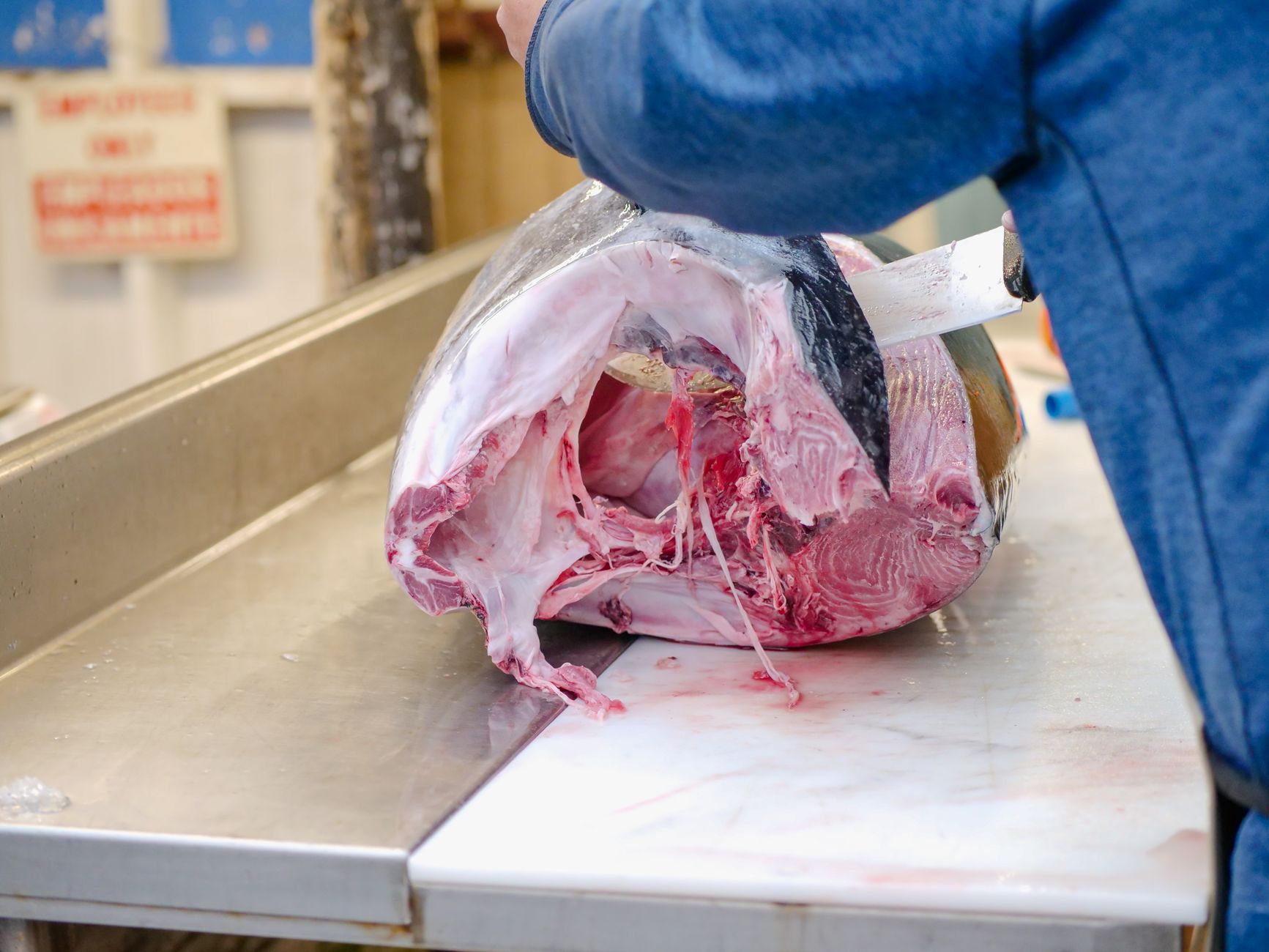
Photo by Kindel Media on Pexels
How big are yellowfin tuna?
Yellowfin tuna are much larger than skipjack and albacore. Many adult yellowfin measure between 1 and 1.5 meters long and weigh 20 to 60 kilograms. Exceptional fish can approach 2.4 meters and exceed 200 kilograms.
The species gets its name from its bright yellow dorsal, anal, and finlet structures. Yellowfin also have a distinctive yellow stripe running along the sides. Their body is sleek and muscular, built for sustained high-speed swimming in warm ocean waters.
Yellowfin are common in commercial and recreational fisheries. Smaller fish may be sold as steaks or used in canned products, while larger individuals are popular for sashimi and other raw preparations where local food-safety rules permit. The exact size of a market fish depends on the fishing method, region, and customer demand.
How big are bigeye tuna?
Bigeye tuna usually grow to around 1 to 1.5 meters and weigh roughly 30 to 100 kilograms. Large adults can reach about 2.5 meters and weigh more than 200 kilograms, making them comparable in size to large yellowfin and smaller bluefin.
Bigeye have relatively large eyes because they often hunt at greater depths and in lower light than many other tuna. Their body is deep and powerful, with a high proportion of muscle. That shape can make a bigeye look especially heavy for its length.
Bigeye are prized in fresh fish markets, particularly for sashimi. Their size, fat content, and firm texture can make them commercially valuable, but those qualities also increase fishing pressure on mature fish. A large bigeye represents years of growth and reproduction, not just a bigger portion of meat.
How big are bluefin tuna compared with people?
A medium bluefin tuna may be longer than an average adult person and weigh several times as much. A large Atlantic bluefin can be more than twice a person’s weight and nearly twice a person’s length, depending on how the fish is measured.
Length measurements usually run from the tip of the snout to the end of the shortest natural tail position, although fisheries may use different measurement rules. Weight is harder to compare because a fish loses water, blood, and internal organs during processing. A whole fish, dressed fish, and fillet therefore have different reported weights.
For a simple comparison, a 60-kilogram yellowfin is roughly the weight of an adult human, while a 300-kilogram bluefin is closer to the weight of a large piano. These comparisons are only visual aids; tuna are dense, muscular fish, so their weight can be surprising when seen beside a person.
How fast do tuna grow?
Many tuna grow rapidly during their first years of life. Skipjack can reach commercial size in a relatively short period, while bluefin continue growing for many years and become much heavier with age.
Growth is not identical across every population. Warm water, abundant prey, and low competition can support faster growth, while limited food or colder conditions can slow it. Scientists estimate age by examining growth rings in structures such as the fish’s ear bones, called otoliths, and by tracking known-size fish over time.
Bluefin tuna are especially valuable to researchers because their age structure affects fisheries management. Removing many large breeding adults can reduce the number of older fish in the population. A fishery may still catch plenty of small tuna while having far fewer of the largest age classes.
Why do some tuna get so large?
Tuna reach large sizes because they combine fast swimming, efficient bodies, and high energy demands. Their tapered shape reduces drag, while their crescent-shaped tails produce strong thrust. Large muscles allow them to chase schooling fish over long distances.
Some tuna can keep parts of their bodies warmer than the surrounding water. This ability, called regional endothermy, helps them maintain strong muscle performance in cooler water and during demanding activity. It does not mean the entire fish is warm-blooded in the same way a mammal is.
Large size can also reduce the number of predators capable of attacking an adult tuna. Young tuna face many predators, but a fully grown bluefin is difficult for most ocean hunters to overpower. The trade-off is that large fish require more food and take longer to replace if a population loses them.

Photo by Atmadeep Das on Pexels
Are tuna bigger in the wild or in fish markets?
The largest tuna in a market are often bluefin, but most retail tuna is far smaller. A fish counter may display a 10-kilogram albacore, a 30-kilogram yellowfin, or a large bluefin loin cut from a fish that originally weighed hundreds of kilograms.
Processing changes how size is described. A “loin” is a boneless section cut from the side of a tuna, while a “steak” is usually a cross-section that may include skin and bone. Neither term describes the weight of the original animal.
Photos can also make tuna look larger or smaller than they are. A fish held close to a camera may appear enormous, while a fish lying on a long deck may look less impressive. A ruler, a known object, or a stated weight provides a more reliable comparison than an image alone.
Frequently Asked Questions
What is the biggest tuna ever caught?
The largest widely recognized tuna catches are Atlantic bluefin weighing more than 600 kilograms. Exact record figures depend on the rules of the organization recording the catch, the condition of the fish, and whether the weight was measured whole or after processing.
How big is a tuna fish in a can?
Canned tuna usually comes from skipjack, yellowfin, or albacore. The original fish may weigh anywhere from a few kilograms to several dozen kilograms, but the can contains processed meat, not the whole fish.
Is a tuna bigger than a shark?
It depends on the shark and the tuna. A large Atlantic bluefin can outweigh many small and medium sharks, but large great white, tiger, whale, and basking sharks are much bigger than any tuna.
How long can tuna live?
Life span varies by species. Skipjack generally have shorter lives, while bluefin can live for decades. Long-lived bluefin have more time to reach exceptional sizes, which is one reason the largest fish are usually older adults.
What is the smallest tuna species?
Black skipjack, also called little tunny in some regions, is among the smallest tuna-like species, although naming can vary between scientific and common classifications. Commercial skipjack tuna are also relatively small compared with yellowfin, bigeye, and bluefin.
Can tuna weigh 1,000 pounds?
Yes, a very large Atlantic bluefin can exceed 1,000 pounds, which is about 454 kilograms. That weight is exceptional rather than typical, and most tuna encountered by anglers, fishers, or shoppers are much smaller.

Mim Creation
Writer at Helmet Today, covering helmet reviews, fit and riding safety.