
Tuna range from about 30 centimeters to more than 4 meters long, depending on the species. The smallest commonly known tuna weigh only a few kilograms, while Atlantic bluefin tuna can exceed 600 kilograms. Most tuna sold for food are far smaller than the biggest fish recorded, often weighing between 10 and 100 kilograms.
How large do tuna get?
“Tuna” describes several related species, so there is no single standard tuna size. A skipjack tuna may fit across a kitchen counter, while a fully grown Atlantic bluefin tuna can be longer than a tall refrigerator and weigh as much as a small car.
Tuna size depends on the species, age, sex, food supply, and location. Some species stop growing at roughly 50 centimeters, while others continue gaining length and weight for many years. Females of the largest species are often heavier than males because they produce millions of eggs during spawning.
| Species | Typical adult length | Approximate maximum size |
|---|---|---|
| Skipjack tuna | 40–80 cm | About 1 m and 20–25 kg |
| Yellowfin tuna | 1–1.5 m | About 2.4 m and over 200 kg |
| Albacore tuna | 90 cm–1.2 m | About 1.4 m and roughly 60 kg |
| Bigeye tuna | 1–1.8 m | About 2.5 m and more than 200 kg |
| Pacific bluefin tuna | 1–2 m | About 3 m and over 450 kg |
| Atlantic bluefin tuna | 1.5–2.5 m | More than 3 m and over 600 kg |
These figures are useful size ranges rather than guarantees. Fish at the upper end are unusual, and different fisheries may report length from different points on the body. A tuna measured from the tip of its upper jaw to the fork in its tail will produce a different number from one measured to the end of the tail.
Which tuna species is the largest?
The Atlantic bluefin tuna is generally considered the largest tuna species. Its scientific name is Thunnus thynnus, and exceptional individuals can reach more than 3 meters in length and weigh over 600 kilograms.
A bluefin of that size is enormous, but most Atlantic bluefin caught today are much smaller. Many commercially landed fish weigh tens of kilograms rather than hundreds. The biggest animals are older fish, and older bluefin are less common because fishing removes many tuna before they reach their maximum size.
Bluefin tuna have a thick, muscular body that is built for sustained swimming. Their size is not simply bulk: the fish have powerful tails, dense muscle, and specialized circulation that helps them keep parts of their body warmer than the surrounding seawater. Those adaptations support long-distance travel and rapid bursts of speed.

Photo by David Dibert on Pexels
The Pacific bluefin tuna, Thunnus orientalis, is also very large. It can approach 3 meters and weigh several hundred kilograms. It lives across the Pacific Ocean and migrates between feeding areas and spawning regions, sometimes crossing the ocean during its life.
Bigeye tuna and yellowfin tuna can also become impressive fish. A very large bigeye may exceed 2 meters and weigh more than 200 kilograms. Large yellowfin can reach a similar length, although the typical adult yellowfin encountered in fisheries is usually smaller.
How big are the tuna people usually eat?
The tuna found in supermarkets and restaurants usually comes from smaller species or from young individuals of larger species. Skipjack is the main tuna used in many canned products, and it commonly weighs between 1.5 and 10 kilograms when caught, although larger skipjack exist.
Albacore tuna are often sold as “white tuna” in canned products. Adult albacore commonly weigh several kilograms to a few tens of kilograms. Their long pectoral fins give them a distinctive appearance, but they remain considerably smaller than mature bluefin.
Fresh yellowfin steaks may come from fish weighing 20 to 80 kilograms, though commercial catches include a wide range of sizes. A single large tuna can supply many portions, but the fish is usually cut and processed at a port rather than brought whole to a retail counter.
Restaurant menus sometimes use names such as “ahi” for yellowfin or bigeye tuna. The name does not identify a particular size. Ahi can refer to fish of very different weights, and the exact species may depend on the fishery and local labeling practices.
How long does it take tuna to reach full size?
Tuna grow quickly when young, but the largest species need many years to reach their full dimensions. Growth is usually fastest during the first part of life, when a small tuna must rapidly increase its body size to avoid predators and compete for food.
Skipjack tuna mature relatively early and do not live as long as bluefin. Bluefin species mature later and can live for decades. Because their bodies keep adding mass over many years, protecting older fish has a direct effect on the number of truly large tuna in the population.
Scientists estimate tuna age by examining structures such as otoliths, which are small calcium-carbonate bones in the inner ear. These structures form growth patterns that can be analyzed much like rings in a tree, although the method requires careful sampling and interpretation.
Size alone does not reveal a tuna’s age with complete accuracy. A well-fed fish in productive waters may grow faster than one in a food-poor area, and males and females can grow at different rates. Age estimates therefore combine body measurements with biological data from many fish.
Why are tuna shaped and built so differently from many fish?
Tuna have a streamlined, torpedo-shaped body that reduces drag while they swim. Their narrow tail base and crescent-shaped tail generate strong thrust, allowing them to cover large distances in open water without the stop-and-start movement common in many reef fish.
Several tuna species are partly warm-bodied, a condition called regional endothermy. Heat produced by swimming muscles can be retained in selected tissues through networks of blood vessels. This helps tuna keep their muscles, eyes, and organs functioning efficiently in cool water.
The largest tuna also have substantial muscle mass around the center of the body. That muscle supports endurance, but it contributes heavily to weight. A bluefin’s mass cannot be estimated accurately from length alone because a thick, well-conditioned fish may weigh much more than a slender fish of the same length.

Photo by Kindel Media on Pexels
How does tuna size compare with other ocean animals?
A large bluefin tuna is bigger than most people expect, but it is not the largest fish in the sea. Whale sharks, basking sharks, and several whales are many times longer and heavier. Tuna are remarkable because they are among the largest fast-swimming bony fish, rather than because they rival the biggest animals overall.
An Atlantic bluefin weighing 300 kilograms would be roughly comparable in mass to a large motorcycle or a very heavy domestic refrigerator. A 10-kilogram skipjack, by contrast, is closer in weight to a full backpack or a medium-sized house cat, although its long, muscular body makes it look much larger than that comparison suggests.
Length comparisons can also be misleading. A tuna may measure 1.5 meters from nose to tail but have a far greater mass than a similarly long, thin fish. Width and body depth matter because they determine how much muscle and internal tissue the animal carries.
What is the biggest tuna ever caught?
Reports of exceptionally large tuna should be treated carefully because records depend on official verification, fishing rules, weighing equipment, and whether the fish was weighed whole. The best-known Atlantic bluefin catches have exceeded 600 kilograms, placing them among the heaviest bony fish ever recorded.
Unofficial claims can be higher, but a reported weight is not automatically a confirmed record. Fish may lose water, blood, and internal contents after capture, while scales can differ in accuracy. For a reliable comparison, a record normally requires documentation, an approved scale, species confirmation, and a precise measurement.
“Largest caught” also differs from “largest that exists.” A fish may die naturally, escape fishing gear, or live in an area where it is rarely targeted. The biggest tuna in the ocean are not necessarily represented in record books.
Does tuna size affect taste and safety?
Size can affect texture, fat content, and the way tuna is sold, but it does not automatically determine quality. Large bluefin are prized in some markets for their fatty belly meat, while albacore and yellowfin have different flavors and textures that suit other dishes.
Large predatory fish can accumulate more mercury over time because mercury builds up through the food web. The exact risk depends on species, serving size, and how often a person eats it. Public-health advice commonly recommends eating a variety of seafood and following local guidance, with extra care for children and people who are pregnant.
Very large tuna also create more concern about sustainability because older breeding fish are valuable to the population. Catching one big fish removes many years of growth and reproductive potential, even though the meat yield may be substantial.
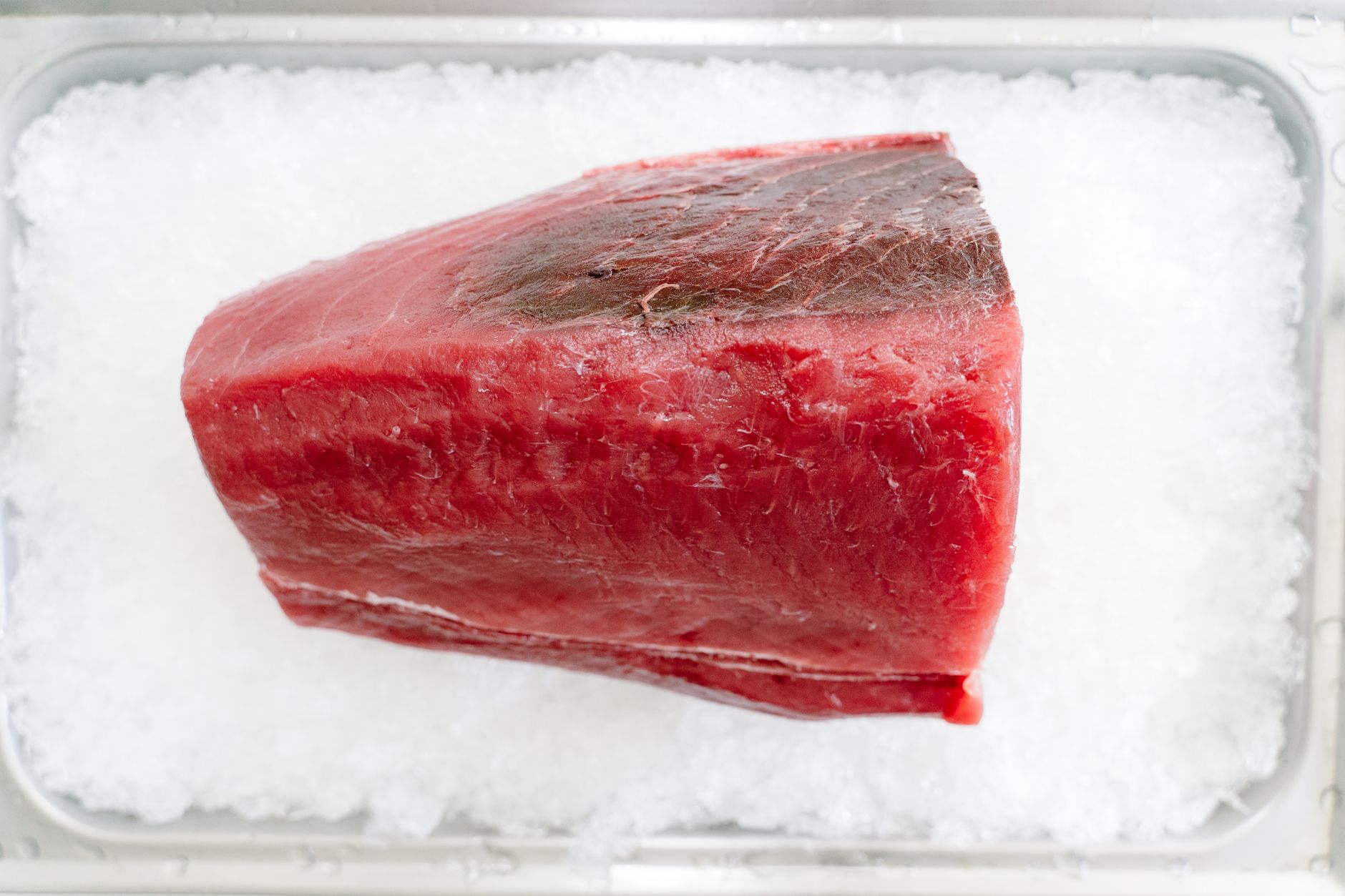
Photo by Deane Bayas on Pexels
Frequently Asked Questions
What is the average size of a tuna?
There is no single average for all tuna species. Skipjack often weigh a few kilograms, while market-sized yellowfin and albacore may weigh from several kilograms to dozens of kilograms. Bluefin caught commercially can range from tens to several hundred kilograms.
Can tuna be bigger than a person?
Yes. Large bluefin tuna can be longer and heavier than an adult human. A bluefin over 2 meters long may weigh several hundred kilograms, although most tuna seen in shops or on restaurant plates are much smaller.
What is the smallest tuna species?
Black skipjack, also called black tuna in some regions, is among the smaller tuna species, often reaching around 50 centimeters and several kilograms. Bullet tuna is also small compared with bluefin, yellowfin, and bigeye tuna.
How heavy is a tuna steak?
A tuna steak sold to a customer commonly weighs about 150 to 300 grams, depending on the shop and portion size. That steak comes from a much larger fish, and commercial processors cut the carcass into loins and portions before sale.
Are canned tuna and fresh tuna the same size?
They can come from the same broad group of species, but canned tuna often uses skipjack, albacore, or smaller yellowfin. Fresh tuna sold as steaks may come from larger yellowfin, bigeye, or bluefin. Processing size and species vary by region and product label.
What makes bluefin tuna so heavy?
Bluefin tuna are long-lived, fast-swimming predators with thick bodies and large amounts of muscle. They can continue growing for many years, and their dense muscle, fat stores, and internal organs add substantial weight as they mature.
For a quick rule of thumb, a tuna may be anywhere from the size of a large loaf of bread to the weight of a small car. The species name matters more than the word “tuna” alone: skipjack is commonly small, yellowfin and bigeye are medium to very large, and Atlantic bluefin reaches the greatest size.

Mim Creation
Writer at Helmet Today, covering helmet reviews, fit and riding safety.