We may earn a commission when you buy through links on this page, at no extra cost to you. Learn more
The best temperature for baking salmon is only useful if your oven and fish temperature are measured reliably. A thermometer can help you avoid relying on appearance alone, while a suitable baking sheet supports even roasting and easier cleanup.
For salmon, the most useful tools here fall into three groups: probe thermometers that measure the food, oven thermometers that check the oven environment, and an infrared thermometer that measures surface temperature. Each solves a different source of uncertainty.
Look for a tool that matches your cooking style. A leave-in probe is practical for monitoring a fillet in the oven, an oven thermometer helps identify temperature differences, and a sheet pan gives salmon room to roast without overcrowding. The infrared option is fastest, but it measures surfaces rather than the inside of the fish.
| Product | Title | Key Features | Price |
|---|---|---|---|
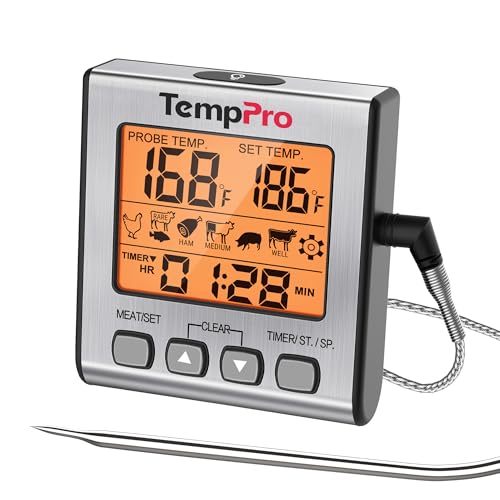 |
#1Best Overall TempPro TempTrack Thermometer Brand: TempPro
|
|
Check Latest Price |
 |
#2Best Value Pair Escali Oven Safe Thermometers Brand: Escali
|
|
Check Latest Price |
 |
#3Best for Ovens OXO Good Grips Oven Thermometer Brand: OXO
|
|
Check Latest Price |
 |
#4Best Baking Pan Martha Stewart Carbon Steel Sheet Brand: Martha Stewart
|
|
Check Latest Price |
 |
#5Best for Surfaces Metris Instruments FI40L Thermometer Brand: Metris Instruments
|
|
Check Latest Price |
What to Look for in Best Temperature For Baking Salmon
- Choose a probe thermometer when you want to measure the salmon itself rather than estimate doneness from the surface.
- Consider an oven thermometer if you suspect the oven display does not reflect the temperature near the food.
- For sheet-pan salmon, look for a wide surface, quick heat response, nonstick coating and raised edges.
- Check the thermometer’s measurement range and whether it supports the temperature scale you use.
- Remember that an infrared thermometer reads surface temperature, so it is not the same as measuring the salmon’s center.
#1 · Best Overall
TempPro TempTrack Thermometer
The TempPro TempTrack is the most versatile choice for cooks who want to monitor salmon continuously while the oven stays closed. Its food-safe probe, 40-inch heat-resistant cable and stated ±1.8°F accuracy are suited to checking the fish during baking, while the 1–2 second updates keep readings current. It measures from 14°F to 572°F, making it useful well beyond salmon.
Six preset meat programs, custom temperatures and doneness alerts make this a strong fit for cooks who prefer reminders instead of repeated door opening. The large LCD, orange backlight, magnet, countertop stand and hanging hole add practical flexibility. Its timer reaches 99 hours and 59 minutes, although that is more useful for long cooking projects than a typical salmon fillet.
Pros
- Food-safe probe with stated ±1.8°F accuracy
- 40-inch heat-resistant cable
- Custom temperatures and doneness alerts
- Large backlit LCD display
- Magnet, stand and hanging hole
Cons
- More features than some salmon-only cooks need
- Requires probe placement in the food
In real-world use, the cable lets the probe remain with the salmon while the display stays accessible outside the oven. The alert can signal when your selected temperature is reached, which is more informative than judging by color alone. The backlight is helpful in dim kitchens, and the 10-second auto-off is designed to conserve battery life.
At the listed $24.99, TempPro costs more than the simple Escali pair or OXO oven thermometer but offers substantially more active monitoring. Compared with the Metris infrared model, it measures the food with a probe rather than taking a quick surface reading. For repeat salmon dinners, that makes it the strongest all-purpose pick.
#2 · Best Value Pair
Escali Oven Safe Thermometers
The Escali AH1 two-pack is a straightforward option for cooks who want a thermometer that can stay in the oven or grill during roasting. Each stainless steel unit has a large dial with Fahrenheit and Celsius markings, plus labeled cooking temperatures for several meats. The leave-in design means you can check progress without repeatedly opening the oven door.
This pair suits traditional kitchens and anyone who prefers an uncomplicated, non-digital display. The thermometers are oven safe, dishwasher safe and made from stainless steel described as resistant to high heat, rust and corrosion. Their 140° to 190°F measurement range is narrower than the TempPro’s, so check that it covers the temperature guidance in your salmon recipe.
Pros
- Two thermometers included
- Leave-in oven and grill design
- Large 2.5-inch-style dial
- Fahrenheit and Celsius markings
- Dishwasher safe stainless steel
Cons
- Narrower 140° to 190°F range
- Dial is less immediate than a digital display
The large dial is designed for quick reference, and the 4.75-inch probe gives it useful reach into roasting foods. Having two thermometers can help when cooking multiple items or keeping a spare available, though dial readings require you to look through the oven window or open the door to inspect them.
At $12.95, this is the least expensive thermometer option in the group and a sensible value for basic oven monitoring. It does not offer TempPro’s custom alerts or rapid digital updates, and it does not replace an oven thermometer such as the OXO. Still, the pair is a practical choice for simple salmon baking.
#3 · Best for Ovens
OXO Good Grips Oven Thermometer
The OXO Good Grips Oven Thermometer is aimed at a different question: whether the oven is actually reaching the temperature shown on its controls. It provides a way to check the oven near the area where your salmon cooks, which matters because temperatures can vary slightly across the interior. It is a useful companion when recipe results seem inconsistent.
Its large Fahrenheit and Celsius numbers are easy to read, and the design can either stand on its wide, angled base or hang from oven wires. The two-point hook is intended to hold it securely on thin or thick wires, while the stable base helps it remain in place when food is added or removed.
Pros
- Checks oven temperature near the food
- Large Fahrenheit and Celsius numbers
- Stable angled base
- Two-point hook for oven wires
- Stays positioned during loading
Cons
- Measures oven air, not salmon’s internal temperature
- Does not provide a food probe or cooking alert
Use the OXO to verify the environment around the salmon rather than to decide whether the fish itself has reached a chosen doneness temperature. Positioning it near where the food cooks is specifically recommended because different areas of an oven may vary. That makes it especially useful for diagnosing uneven baking or an unreliable oven display.
At $17.95, it costs less than the TempPro and is more focused than the Escali food thermometers. It cannot tell you the salmon’s internal reading, so it works best alongside a recipe and, when needed, a food probe. Choose it when oven accuracy is your main concern.
#4 · Best Baking Pan
Martha Stewart Carbon Steel Sheet
The Martha Stewart Gallen sheet is the cookware choice for baking salmon rather than measuring temperature. Its 17-by-11-inch carbon steel surface responds quickly to heat and is designed to distribute it for even baking and roasting. The half-sheet format offers room for salmon, vegetables or other sides without the food feeling crowded.
A nonstick surface helps food release with less oil or butter and makes cleanup easier after a sheet-pan meal. Minimally raised edges and rolled rims are described as warp-resistant, while the wide surface is intended to fit most standard home ovens. It suits cooks who want one pan for salmon, roasted vegetables, cookies and other everyday meals.
Pros
- Wide 17-by-11-inch cooking surface
- Quick heat response
- Nonstick surface for easier release
- Useful for salmon and sheet-pan dinners
- Raised edges and rolled rims
Cons
- Does not measure oven or food temperature
- Only one sheet is included
For salmon baking, the pan gives you a broad, contained surface for arranging the fish and sides. The nonstick finish can reduce the effort needed to release food, and the carbon steel construction is intended to conduct heat evenly. The raised edges are useful for containing ingredients while keeping the pan suitable for roasting.
At $14.54, it is a relatively affordable foundation for sheet-pan cooking, but it cannot replace a thermometer when the best temperature for your recipe needs verification. Pair it with TempPro for internal monitoring or OXO for oven checking. Compared with the other products, this is the item that directly supports the bake itself.
#5 · Best for Surfaces
Metris Instruments FI40L Thermometer
The Metris Instruments FI40L is a non-contact infrared thermometer for fast surface checks. Its dual laser defines a 0.87-inch target area, and the 16:1 distance-to-spot ratio helps with aiming. It provides readings in one second across a stated range of -40°F to 536°F, making it suitable for quick checks around cooking, grilling, baking and food service.
This model is best for cooks who value speed and do not want to insert a probe. It is described as meeting HACCP accuracy guidelines within the 40°F to 140°F danger zones with ±2°F error, and it uses a 9-volt battery for 14 hours of continuous use. The key limitation is that it reads surfaces, not the salmon’s interior.
Pros
- One-second readings
- Dual laser targeting
- 0.87-inch defined target area
- -40°F to 536°F stated range
- Useful for kitchen and grill surfaces
Cons
- Measures surface temperature rather than internal doneness
- Highest listed price at $69.99
The laser targeting can make it easier to check a specific area without touching the food, cookware or oven surface. That is convenient for rapid checks, but an infrared reading should not be treated as the same measurement as a probe inserted into salmon. Surface conditions can differ from the temperature inside the fillet.
At $69.99, this is the most expensive product listed and is most compelling for people who also need quick non-contact checks for grills, buffets, coolers or commercial kitchen work. For ordinary salmon baking, TempPro offers more directly relevant internal monitoring, while OXO is the simpler choice for checking oven temperature.
Frequently Asked Questions
What temperature should I use for baking salmon?
The product information does not specify a single baking temperature for salmon, so follow the temperature in your chosen recipe. The OXO can help verify that the oven reaches that setting, while TempPro can monitor the fish as it cooks.
Which thermometer checks salmon most directly?
TempPro is the most direct option because it uses a food-safe probe and supports custom temperatures with doneness alerts. The Escali thermometers also use probes, while the Metris FI40L measures the surface without contact.
Can an infrared thermometer tell when salmon is done?
The Metris FI40L provides fast surface readings, but its product information describes it as a non-contact surface thermometer. It therefore does not provide the same internal reading as a probe placed into the salmon.
Why use an oven thermometer when baking salmon?
An oven thermometer helps you check the actual temperature near where the food cooks, since temperatures can differ across the oven. The OXO is designed to stand or hang securely in that position.
Do I need a special pan for baking salmon?
No special salmon-only pan is identified in the product data, but the Martha Stewart sheet is designed for baking salmon and sheet-pan dinners. Its wide nonstick surface, quick heat response and raised edges support convenient roasting and cleanup.
Final Thoughts
For the most controlled salmon bake, choose TempPro TempTrack: it measures with a probe, updates quickly and can alert you at a custom temperature. Add the Martha Stewart sheet if you want a roomy, nonstick surface for salmon and sides.
Choose OXO when oven accuracy is the concern, Escali for a low-cost leave-in pair, and Metris when rapid surface checks matter more than internal readings. Whichever tool you select, use your recipe’s stated baking temperature and match the thermometer to the measurement you actually need.

Mim Creation
Writer at Helmet Today, covering helmet reviews, fit and riding safety.